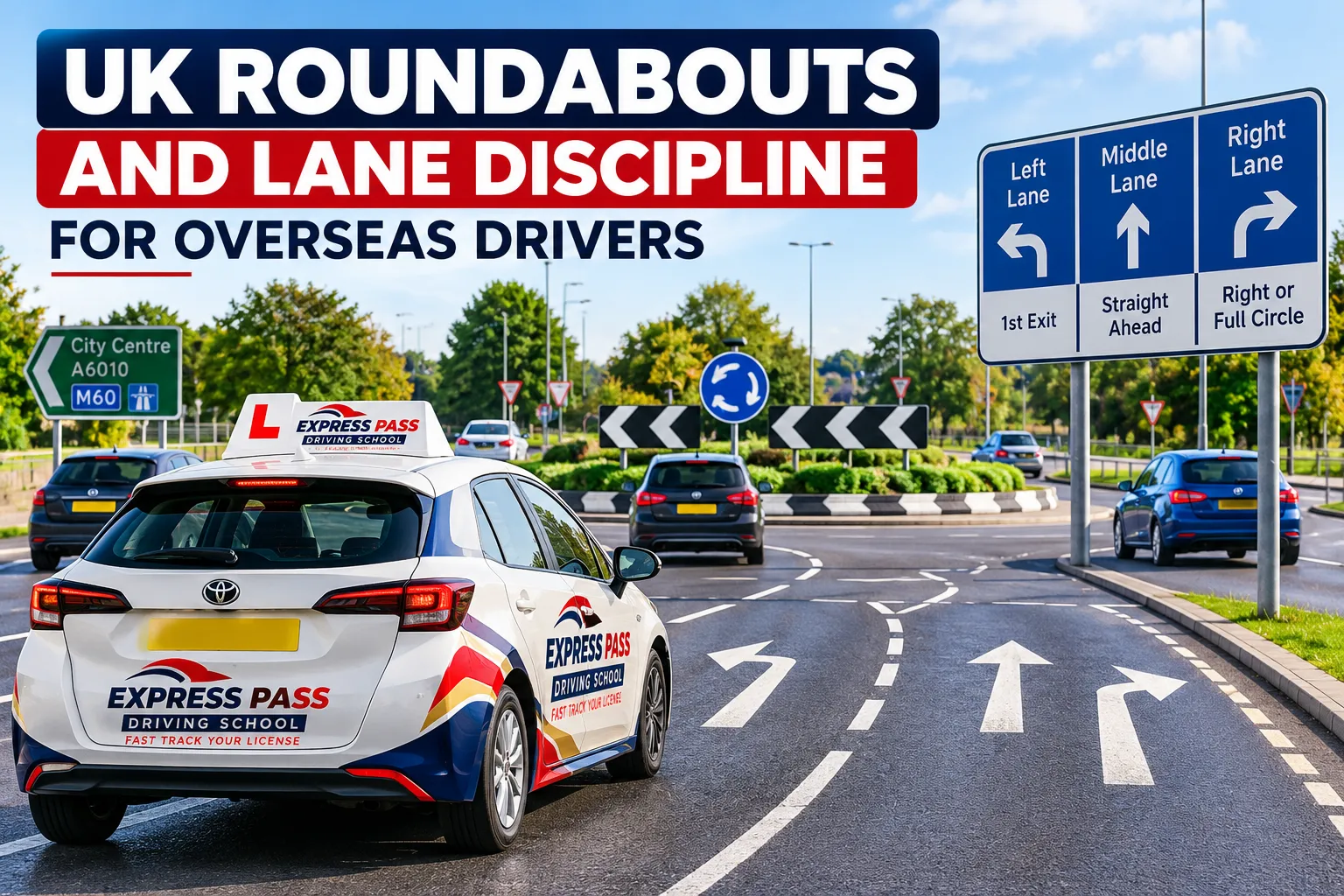
UK Roundabouts and Lane Discipline: A Guide for Overseas Drivers
Roundabouts can be one of the more confusing parts of adapting to driving in Britain. Even if you have used roundabouts for years, the layout, lane markings and signalling conventions may be different from what you are used to.
The biggest improvement often comes from planning earlier. Rather than arriving at the entrance and trying to work everything out at once, read the signs, choose your lane and think about your exit while you still have time.
Your three exits at a glance
- Taking the first exit (left)
Lane: left-hand lane
Signal: left on approach - Going straight ahead
Lane: as the signs and markings show
Signal: not normally needed on approach - Turning right or full circle
Lane: right-hand lane
Signal: right on approach
This is the usual pattern on a conventional roundabout. Always follow the signs, markings and road layout in front of you.
Start before you reach the roundabout
Look for direction signs as you approach. They may show destinations, road numbers, lane arrows or which lane you should use for a particular exit.
Road markings on the approach can also be important. Follow the arrows and lane guidance rather than assuming that the left lane is always correct for going straight ahead. The appropriate lane depends on the layout and the signs.
Reduce your speed enough to assess the traffic and select your position safely. Avoid changing lanes at the last moment because you suddenly realise you are in the wrong one.
Taking the first exit
For a conventional roundabout, when taking the first exit to the left, you would normally approach in the left-hand lane, signal left and keep to the left around the roundabout, unless signs or markings indicate otherwise.
Before entering, check the traffic and give way as required. Continue to observe as you move around the roundabout, and make sure your exit is clear before leaving.
Do not focus solely on vehicles coming from the right. Cyclists, pedestrians and other road users may also be nearby, particularly at busy urban roundabouts.
Going straight ahead
For an intermediate exit, the approach signal is not normally needed unless signs or markings indicate otherwise. Choose the appropriate lane based on the direction signs and road markings, then stay in that lane until you need to change course to leave.
As you pass the exit before the one you want, signal left when appropriate and check that you can leave safely. Do not cut across another lane to reach your exit.
Some roundabouts have spiral markings or lane arrangements that guide you towards the correct exit. Follow those markings rather than relying on a rule you remember from a different roundabout.
Taking an exit to the right
When turning right or going full circle on a conventional roundabout, you would normally approach in the right-hand lane and signal right, unless signs or markings indicate otherwise.
Remain in the appropriate lane while travelling around the roundabout. As you pass the exit before the one you want, signal left and check that it is safe to leave.
This is where planning matters. If you realise you are in the wrong lane, do not force your way across traffic. Continue only if you can do so safely and legally, and follow the road layout rather than making a sudden manoeuvre.
The exact approach can vary, so use the signs, markings and road layout at the roundabout in front of you.
Mirror checks and blind spots
Roundabouts involve more than steering and signalling. You need to know what is happening around the vehicle, especially when changing lanes or leaving.
Before moving across a lane, check your mirrors and the relevant blind spot, signal when appropriate and move only when there is a safe gap. A signal tells others what you intend to do. It does not give you priority.
Also be aware of motorcycles and bicycles. They can be harder to see, and their position or speed may differ from what you expect.
What about mini-roundabouts?
Mini-roundabouts should not be treated as ordinary crossroads with a painted circle in the middle. You generally need to give way to traffic from the right and pass around the central marking, unless the size or layout of the vehicle and junction makes that impractical.
Because mini-roundabouts can be small and visibility may be restricted, approach at a speed that gives you time to assess the junction. Avoid cutting across the markings simply because the roundabout looks small.
For the detailed rules, refer to the Highway Code's guidance on roundabouts and the official road marking guidance.
Common mistakes to avoid
A few habits can make roundabouts harder than they need to be:
- ✕ Choosing a lane too late
- ✕ Following a familiar rule instead of reading the signs at the actual junction
- ✕ Signalling without checking that the signal reflects your intention
- ✕ Changing lanes without proper observations
- ✕ Focusing on the exit and overlooking cyclists, pedestrians or nearby vehicles
- ✕ Making a sudden move when you realise you have missed the correct lane
The solution is not to memorise one rule for every roundabout. It is to combine early planning, appropriate positioning, good observations and clear signals.
Practise on different types of roundabout
A quiet, single-lane roundabout is very different from a busy multi-lane junction with traffic lights, lane arrows and heavy traffic. Practising on different layouts helps you learn how to read each one rather than relying on memory alone.
If you have recently moved to the UK, a driving instructor can also help you understand how roundabout decisions are assessed during a practical test. You can practise choosing lanes, making observations and responding safely when the traffic does not behave as expected.
If you are in Manchester and already have driving experience, Express Pass offers international driving lessons and assessments for overseas drivers. An assessment can help identify whether roundabouts, junctions or other UK-specific skills need more work.
The goal is to make your decisions earlier and your driving more predictable, not to rush through a roundabout just because other drivers seem impatient.
Keep reading
Guide 1
Driving in the UK for the First Time
Keeping left, junctions, road signs, speed limits and licence rules.
Guide 2
Preparing for a UK Driving Test When You Already Know How to Drive
What the practical test assesses and how a mock test can help.
Want a second pair of eyes on your driving?
Tell us how long you have been driving and where, and we will suggest a sensible starting point.
Message us on WhatsApp
Call 07587 867373