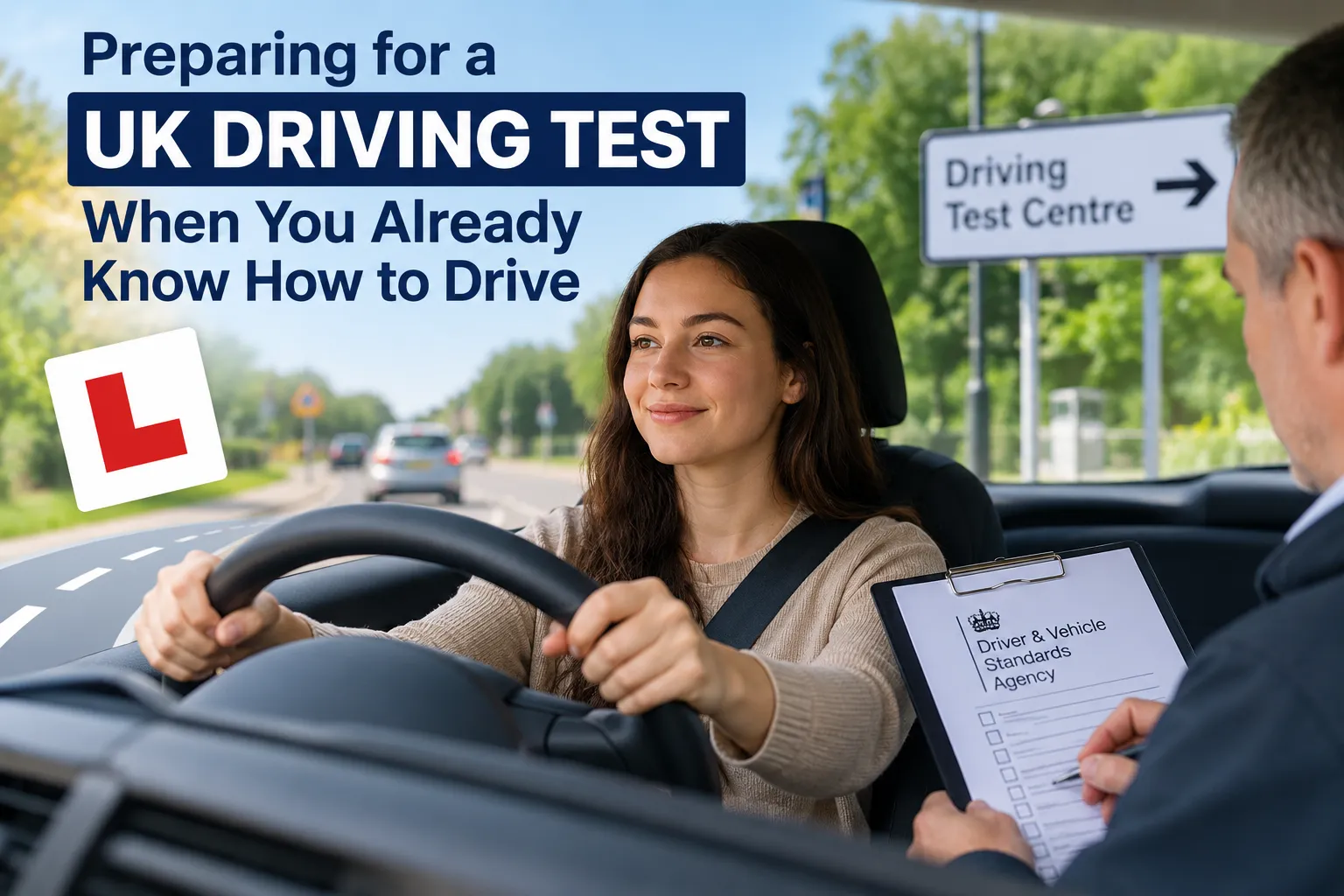
If you have been driving for years, taking a driving test in another country can feel a little odd. You might be perfectly comfortable in traffic, able to park without thinking twice and confident on unfamiliar roads. Yet preparing for a UK practical test can reveal habits you never needed to question before.
That is because experience and test readiness are not quite the same thing. The aim is not to pretend you are a beginner. It is to understand what the UK test expects and make sure your driving meets that standard.
First, check which test you actually need
Before booking lessons or a test, establish whether you can exchange your existing licence or drive in Great Britain using it. The rules depend on your licence and circumstances.
Start with the official GOV.UK non-GB licence guidance. If you need a UK licence, check the licence exchange service and follow the instructions relevant to your situation.
If you do need to take a UK practical test, make sure you understand the requirements before spending money on preparation.
What happens during the UK practical test?
The car driving test includes:
- ✓ An eyesight check
- ✓ Vehicle safety questions
- ✓ General driving ability
- ✓ A reversing exercise
- ✓ Independent driving
During independent driving, you follow directions from a sat nav, traffic signs or a combination of both. You will not be assessed only on whether you can control the car. Your examiner also needs to see that you make safe decisions, observe properly, respond to hazards and follow the rules of the road.
You can read the current details in the official GOV.UK guide to what happens during the driving test.
The habits worth checking before your test
1. Observations at junctions
An experienced driver may make decisions almost automatically. That can work well in familiar surroundings, but in a test you need to show that you have checked the road properly before acting.
Practise approaching junctions at a suitable speed, looking for pedestrians and cyclists, judging gaps and moving only when it is safe. If visibility is restricted, think about whether you need to adjust your position to improve your view without putting yourself in danger.
2. Positioning and lane choice
Driving on the correct side of the road is only the beginning. You also need to position the car appropriately when approaching junctions, following bends, passing parked vehicles and changing lanes.
Roundabouts deserve particular attention. Read the signs early, choose the appropriate lane and avoid last-minute changes that could affect other road users. Our guide to UK roundabouts and lane discipline explains how to plan each exit.
3. Speed and planning
Being able to drive quickly does not mean you are driving well. The examiner needs to see that you can select a safe speed for the conditions, anticipate hazards and make decisions in good time.
Look beyond the vehicle directly ahead. Consider parked cars, side roads, pedestrian crossings and changes in the road layout. Good planning often makes your driving look calmer because you have more time to respond.
4. Independent driving
You may be asked to follow a sat nav or road signs. You do not have to be perfect at navigation, and taking a wrong turn does not automatically mean you have failed.
What matters is how safely you respond. If you miss an exit, do not make a sudden lane change or take a risky turn to get back on route. Continue safely and follow the examiner's directions.
5. Reversing manoeuvres
You may already be comfortable parking at home, but the UK test assesses how safely and accurately you carry out a selected manoeuvre. Practise the relevant exercises while maintaining good observations and awareness of people or vehicles nearby.
Do not concentrate so hard on getting the car into the space that you stop checking what is happening around you.
Why a mock test can be useful
A mock test gives you a chance to experience a more formal assessment before the real day. It can reveal things that are easy to overlook when driving with someone who knows you well.
For example, you might discover that you check mirrors less consistently than you thought, approach roundabouts too quickly or wait unnecessarily at junctions. These are specific problems you can work on, rather than vague instructions to “drive better”.
A good mock test should lead to useful feedback. Ask:
- ? Which faults occurred?
- ? Why did they matter?
- ? What should I do differently next time?
One mistake does not tell the whole story. Recurring patterns are often more helpful to identify.
Do you need a full course of lessons?
Not necessarily. Some overseas drivers need only a limited amount of UK-specific practice, while others discover gaps that require more time.
The sensible approach is to assess your driving first, then decide what training is appropriate. Booking a large package before anyone has seen you drive may not be the best starting point if you are already experienced.
Express Pass offers international driving lessons in Manchester for overseas drivers who want to adapt to British roads or prepare for a UK practical test. Its two-hour international driver assessment is designed to identify areas for improvement and help you decide on the next steps.
The aim is to prepare properly, not to promise a pass by a particular date. Go into the test when your driving is safe, consistent and ready for independent assessment.
Ready to find out where you stand?
Tell us how long you have been driving and which country you drove in, and we will suggest a sensible next step.
Message us on WhatsApp
Call 07587 867373
Related guides: Driving in the UK for the First Time, UK Roundabouts and Lane Discipline, Am I ready for my driving test? and driving test faults explained.