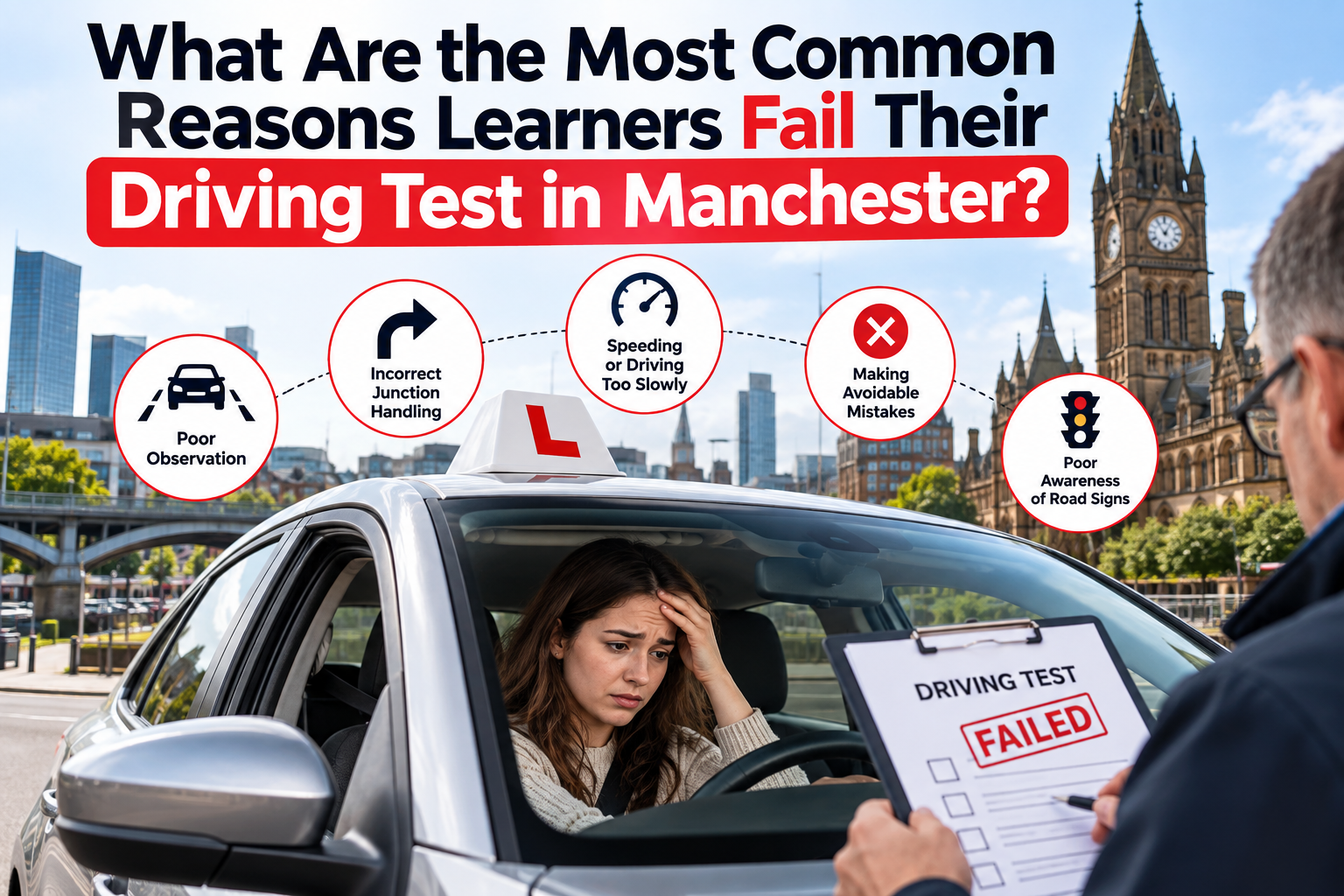
Most learners who fail their driving test in Manchester are not bad drivers. In fact, the common reasons learners fail their driving test are small habits that slip under pressure: a missed mirror check, a rushed junction or a wobbly manoeuvre. The good news is that every one of them can be fixed with the right practice before test day.
Below, our DVSA approved instructors explain how the test is marked, the faults that catch people out most often, and exactly what to practise so they don’t happen to you.
How the Driving Test Is Marked
First, it helps to know how a fail actually happens. The examiner records three types of fault:
- Driving faults (minors) — not dangerous on their own, but you can have no more than 15.
- Serious faults — something that could have been dangerous. One serious fault means a fail.
- Dangerous faults — actual danger to you, the examiner or other road users. One means a fail.
Also, repeating the same minor fault can turn it into a serious one. So a single habit, such as forgetting your right mirror, can fail a test on its own. For a full breakdown, read our guide to driving test faults explained, or see the official rules on GOV.UK.
The Most Common Reasons Learners Fail Their Driving Test
DVSA’s published figures put the same two faults at the top year after year. After those, the list is made up of a familiar group of errors. Here is what each one means and how to fix it.
1. Poor observation at junctions
This is the number one reason learners fail their driving test. It usually means pulling out without looking properly, looking but not really seeing, or creeping out when the view is blocked. Instead, slow down early, look right, left and right again, and take a second look when parked cars or hedges block your view. If you can’t see, you don’t go.
2. Not using mirrors when changing direction
Before you signal, change lanes, speed up or slow down, the examiner expects a mirror check. Learners often check the interior mirror but forget the door mirror, especially before turning left near cyclists. Practise saying “mirrors, signal, manoeuvre” in your head until it becomes automatic.
3. Moving off unsafely
Moving away from the kerb is simple, but nerves make people rush. A safe move-off needs all-round checks, including your blind spot, every single time — even after a short stop at the side of the road.
4. Wrong position when turning right
At junctions and on multi-lane roads, you need to sit just left of the centre line when turning right. Drifting too far left blocks traffic behind you, while cutting the corner puts you in the path of oncoming cars.
5. Not responding properly to traffic lights and signs
For example, learners stop too late on amber, miss a filter arrow or ignore a lane marking. Read the road ahead early so each decision is calm rather than sudden.
6. Steering control and road position
Crossing hands badly, clipping the kerb or wandering towards the centre of the lane all count. Similarly, poor positioning during normal driving, such as sitting too close to parked cars, is marked down.
7. Manoeuvres and reverse parking
Touching the kerb, ending up badly parked or forgetting observation during a reverse are common test day mistakes. The examiner cares as much about your checks for other road users as your final position.
Why Manchester Tests Feel Harder
Greater Manchester test routes include busy multi-lane roundabouts, bus lanes, cycle lanes and heavy traffic at peak times. As a result, the junction and mirror faults above show up even more. Each centre is different, so it pays to practise on the roads near yours. Our guides to the Cheetham Hill test centre and every other local centre on our test centres and pass rates page cover the roads and hotspots to expect.
How to Avoid Failing Your Driving Test
- Take a mock test. A full mock test with your instructor shows your weak spots under test conditions.
- Drive the local roads. Practise the roundabouts and junctions around your test centre until they feel routine.
- Fix habits early. Ask your instructor which minor faults you repeat, then work on those first.
- Know the “show me, tell me” questions. Revise them with our free Show Me, Tell Me practice tool.
- Plan test day. Use our driving test day checklist so nothing rushes you on the morning.
- Check you are ready. Try our am I ready for my driving test guide before you book.
Failed Already? Here’s What to Do Next
Failing is common, and it doesn’t mean you are a poor driver. Read your marking sheet, note which faults appeared, and book a few focused lessons on those areas. Our failed driving test: what next guide walks through the steps.
If you want to get ready quickly, an intensive driving course with Express Pass gives you concentrated practice on Manchester test routes with a DVSA approved instructor. Call us or send a WhatsApp message and we’ll help you choose the right course.