Beginner's Offer: 5 Hours for Only £125 Book Now
Manchester’s #1 Intensive Driving School
Categories
Driving school in Manchester

How Intensive Driving Courses Work

Need to pass quickly because uni is starting, a new job depends on it, or you are simply tired of dragging lessons out for months? That is usually when people start asking how intensive driving courses work. The short answer is simple: instead of spreading lessons across half a year, you compress your training into a shorter, focused period so you can build momentum, improve faster and reach test standard sooner.

That speed is the main attraction, but the process is more structured than many learners expect. An intensive course is not just a random stack of long lessons. Done properly, it is a planned route from your current level to test readiness, with the right number of hours, the right instructor and a schedule that gives you enough repetition to improve without losing progress between sessions.

How intensive driving courses work in practice

Most intensive driving courses begin with one key question: where are you starting from? A complete beginner needs a very different plan from someone who has already done 20 hours and just needs polishing before a test. That is why a good course starts with an assessment of your current ability, confidence and experience.

From there, the course is matched to you. Some learners need a full beginner package. Others need a shorter course built around weak areas such as roundabouts, clutch control, independent driving or manoeuvres. If you have recently failed a test, your plan may be even more focused, with extra work on the faults that held you back.

The lessons are then organised over a condensed timescale. That might mean training over one week, two weeks or slightly longer depending on your availability and your starting point. The exact timetable varies, but the idea stays the same: regular, concentrated driving time with fewer long gaps between lessons.

That matters because consistency speeds up learning. When you drive several times in a short period, you remember more from the previous lesson. You spend less time re-learning and more time improving. For many learners, that makes intensive training feel sharper, more efficient and less frustrating than the stop-start pattern of one lesson a week.

What happens before the course starts

Before you get behind the wheel, there is usually some planning involved. You will need to choose whether you want manual or automatic lessons, confirm your availability and discuss what kind of support you need. Some learners also prefer a female instructor, which can make a real difference to comfort and confidence.

You also need the course to fit your actual goal. If you are starting from scratch, the aim is to cover the full range of skills needed to drive safely and confidently. If you are nearly test-ready, the aim is to tighten up the details and prepare you to perform under pressure. Those are two different jobs, so the right course length matters.

This is where many people get it wrong. They assume faster means fewer hours. It does not. Intensive means the same learning is delivered in a shorter window, not magically skipped. If you need 30 or 40 hours to reach standard, the smart move is to book a course that reflects that, rather than choosing the shortest option and hoping for the best.

What a typical intensive course looks like

A typical course is made up of longer driving sessions across consecutive days or closely spaced dates. That gives you time to settle into the lesson, work on multiple skills in one go and build confidence through repetition. Short weekly lessons can be useful, but they often end just as you are getting into rhythm. Intensive sessions remove that problem.

Early in the course, the focus is usually on core control and road awareness. That includes moving off safely, stopping, steering, gears if you are learning manual, speed control, observations and dealing with everyday traffic. Once those basics are more secure, the lessons move into more demanding situations such as larger roundabouts, busier junctions, dual carriageways, manoeuvres and independent driving.

As the course progresses, your instructor should keep linking one lesson to the next. That continuity is one of the biggest advantages. Instead of revisiting the same mistakes every week, you can correct them, practise them again the next day and turn them into stronger habits.

Near the end, the focus usually shifts to test readiness. That means sharpening decision-making, reducing repeated faults and building the calm, consistent standard needed on test day. Mock tests can help here because they show whether you are really ready or just feeling hopeful.

Who intensive courses suit best

Intensive courses work especially well for learners who are motivated and clear on their goal. If you want to pass fast and you can commit time and energy to the process, this format can be highly effective. It is often a strong fit for students on a deadline, job seekers who need a licence quickly, working adults with limited free time, and retest candidates who want a focused reset.

They can also suit anxious learners better than people assume. Some nervous drivers do well with momentum because they stop overthinking between lessons. Driving becomes familiar more quickly when you do it often.

That said, intensive is not automatically right for everyone. If your schedule is chaotic, if you struggle with fatigue during long lessons, or if you prefer extra time to process each stage, a slower plan may be better. Fast only works when the structure fits the learner.

How the test side usually fits in

One reason people search for how intensive driving courses work is that they want to understand how the course lines up with the practical test. In a well-run programme, your lesson plan is built around getting you ready for that standard as efficiently as possible.

That does not mean every course ends with an immediate test no matter what. The better approach is honest guidance. If you are ready, the training should bring you to test level and keep you sharp. If you are not ready yet, it is better to know early and adjust the plan than rush into a poor result.

It also helps to prepare beyond the driving itself. Theory support, mock tests and practical guidance on finding suitable test options can make the whole process smoother. The strongest intensive courses do not just sell hours. They reduce uncertainty from start to finish.

The biggest benefits and the real trade-offs

The obvious benefit is speed. If you need a licence quickly, intensive learning can move you forward far faster than weekly lessons. There is also a financial advantage for some learners because concentrated training can reduce wasted recap time and help you progress more efficiently.

Confidence is another major gain. Driving repeatedly over a short period often helps skills stick. You see the same road types, repeat the same routines and improve without the long gaps that can knock confidence back.

But there are trade-offs. Intensive courses require commitment. You need to be mentally switched on, open to feedback and prepared for a lot of learning in a short time. They can feel demanding, especially for complete beginners in the first few days.

There is also no honest guarantee that every learner will pass within a set number of hours. Progress depends on experience, confidence, attitude, lesson quality and how quickly you adapt. A good school will be clear about that while still giving you a focused path to the fastest realistic result.

How to choose the right intensive course

The best course is the one that matches your level, not the one with the boldest promise. Look for clear options for beginners, partly trained learners and retest candidates. Make sure the instructors are DVSA-approved and that the school offers proper guidance on course matching rather than pushing everyone into the same package.

You should also look at the support around the lessons. Mock tests, theory help, flexible scheduling and straightforward communication all matter when time is tight. So does transparency. If a provider offers a money-back guarantee on unused lesson hours, that is a strong sign they are confident in the value of the course and fair in how they operate.

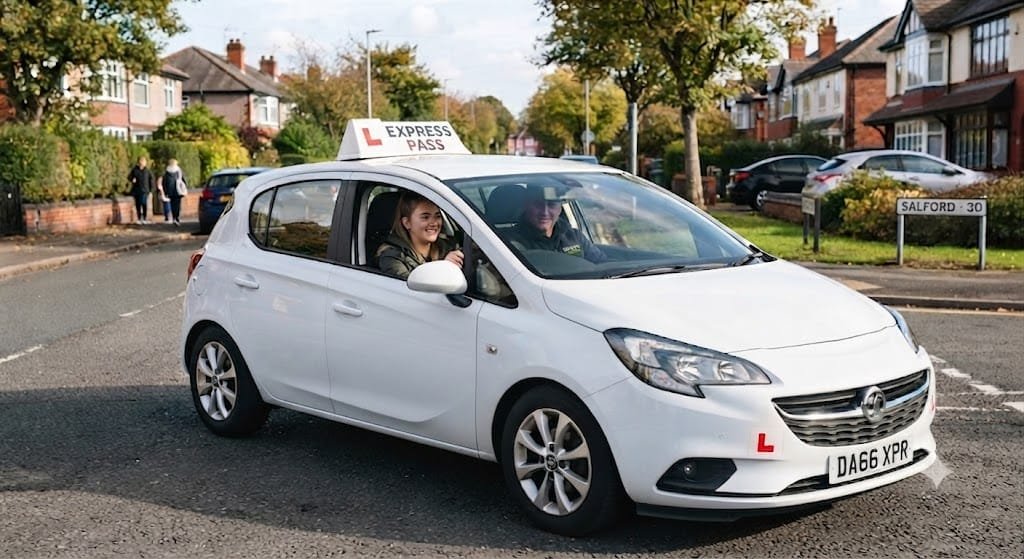
If you are learning in Manchester, choosing a school that understands local roads, local test expectations and the pressure learners are under can make the process feel much more direct. That is where a specialist provider such as Express Pass can make a difference, especially if your priority is getting on the road fast without losing the structure that helps people pass properly.

What to expect from yourself

An intensive course gives you momentum, but you still need to bring the right mindset. Be ready to listen, ask questions and keep working on weak areas instead of avoiding them. Some days will feel strong, others will feel messy. That is normal.

Progress in driving is rarely perfectly linear. You might nail bay parking one day and overthink it the next. What matters is the overall pattern. With the right instructor and enough concentrated practice, those ups and downs usually settle into solid improvement.

If you want fast progress, structure beats guesswork every time. The right intensive course gives you a clear route, proper support and enough focused time behind the wheel to move from learner to test-ready without dragging the process out for months. If passing matters now, not later, that can be exactly the push you need.

Categories
Driving school in Manchester

Driving Lessons After Failing Test

Failing a driving test can feel brutal for about 24 hours. Then it becomes useful. If you handle it properly, driving lessons after failing a test can turn a frustrating result into a much faster pass next time. The key is not booking random lessons and hoping for the best. You need targeted practice, honest feedback and a clear retest plan.

Most learners do not fail because they are hopeless drivers. They fail because of a few repeated faults, poor nerves management, or a gap between lesson driving and test driving. That is fixable. Often quicker than people expect.

Why driving lessons after failing a test matter

A failed test gives you something many learners never get before test day – real evidence. You are no longer guessing what might go wrong. You have a marking sheet, a route experience and a clear record of where pressure affected your driving.

That matters because the best driving lessons after failing a test are not about starting from scratch. They are about tightening weak areas and getting you test-ready again without wasting time or money on things you already do well.

Some learners need only a few focused hours. Others need a short intensive block to rebuild consistency. It depends on why they failed. One serious fault at a roundabout is very different from a test full of repeated issues with mirrors, positioning and speed control. The right lesson plan should reflect that.

First, look at why you failed

Before you book anything, read the test report properly. Be honest with yourself here. If you failed on observation at junctions, that is not just bad luck. If you picked up several minors for hesitation, that may be confidence, judgement or both. If your serious fault happened right at the end, nerves may have played a bigger part than your overall driving standard.

A useful instructor will break the result into three areas. First, what caused the fail. Second, what nearly caused more faults. Third, what was actually done well and should be left alone. That last part matters. Learners often come back after a fail feeling they cannot drive at all. That is rarely true.

The biggest mistake after a failed test

The worst move is waiting too long and letting your confidence drop further. Skills fade. So does sharpness. If you put it off for weeks without a plan, the retest becomes harder than it needs to be.

The second mistake is doing too much unfocused driving. More hours do not automatically mean better results. If you spend lesson after lesson driving around comfortably but never fixing the actual test faults, you are just paying to stay busy.

That is why a structured approach works better. Focused lessons, mock test pressure, and direct feedback usually move retest candidates on much faster than open-ended practice.

What your lessons should focus on after failing

Fix the serious fault first

Start with the issue that failed the test. If it was lane discipline on a roundabout, work on roundabouts in different traffic conditions until your decisions become automatic. If it was meeting traffic, practise clearance, timing and speed. If it was a controlled stop or manoeuvre, repeat it until the routine feels calm rather than rushed.

Do not bury the problem under easier driving. Face it early and repeat it properly.

Deal with repeated minors

Minors matter because they often show a pattern. A few mirror faults can mean your routine is inconsistent. Repeated hesitation can suggest you are seeing hazards late or second-guessing yourself. Several issues with progress might mean you are driving too cautiously to feel safe under test conditions.

These are often easier to fix than learners think, but only if someone points out the pattern clearly.

Rebuild test-day composure

A lot of people can drive well enough to pass, but not when they know every move is being marked. That does not mean they need months more lessons. It means they need realistic test-style practice.

Mock tests help because they bring pressure back into the car. So does driving unfamiliar roads, dealing with silence from the instructor, and being expected to make independent decisions without prompts. Retest preparation should include all of that.

How many lessons do you need?

There is no honest one-size-fits-all answer. If you failed for one clear mistake and your driving was otherwise solid, you may only need a few hours before you are ready again. If your report shows several weak areas, a short intensive course can make more sense because it builds momentum and consistency quickly.

For busy learners in Manchester, this is often the deciding factor. Weekly lessons can work, but if you want to get ready quickly, concentrated training usually gets better results. You stay in rhythm, correct faults faster and spend less time relearning what you did the previous week.

This is especially useful if you need your licence for work, uni, commuting or simply getting your independence sorted without dragging the process out.

Should you stay with the same instructor?

Sometimes yes, sometimes no. If your instructor knows your weaknesses, gives clear feedback and has a proper retest plan, staying with them can save time. They already know where your driving breaks down under pressure.

But if lessons have felt vague, repetitive or over-comfortable, a fresh pair of eyes can help. Some retest learners improve quickly because a new instructor spots habits that were being missed. The point is not loyalty. The point is progress.

If you switch, bring your test report and be upfront about what happened. A good instructor will not judge you for failing. They will use the result to build a sharper plan.

Manual or automatic after a fail?

This comes up more often than people expect. If you failed in a manual because of gear control, clutch issues or stalling under pressure, it is worth asking whether manual is still the right route for you. For some learners, staying manual is sensible because they are close. For others, automatic lessons speed everything up and remove the problem that keeps costing them confidence.

It depends on your goal. If you need to pass quickly and get on the road for work or daily life, automatic can be the more practical choice. If you are handling the car well and the fail was unrelated, changing may not be necessary.

The smartest choice is the one that gets you safely to a pass, not the one that sounds toughest.

How to use your next lessons better

Go into each lesson with a purpose. Tell your instructor exactly what came up on your test and what still feels shaky. Ask for direct feedback, not vague reassurance. If a roundabout is a problem, spend real time on roundabouts. If independent driving made you tense, practise following signs and sat nav directions until it feels normal.

Also, ask for at least one realistic mock test before your retest. This is where many retest candidates sharpen up. A mock exposes whether the issue is truly fixed or just improved when someone is helping you through it.

If you are in Manchester and want a faster route back to test standard, a school like Express Pass can be a strong fit because the training is built around structure, speed and focused support rather than endless weekly lessons.

Confidence after failing is not the same as comfort

A lot of learners say they want confidence back. What they actually need is consistency. Confidence built on comfort disappears as soon as the examiner gets in the car. Confidence built on repeated, corrected practice tends to hold up much better.

That is why the right post-fail lessons can feel demanding. You should be pushed a bit. You should be made to think. You should practise the roads, situations and decisions that exposed your weak spots. That is how confidence becomes earned rather than forced.

When are you ready to rebook?

You are ready when the original fail point has been fixed consistently, your recurring minors are under better control, and you can drive to a safe standard without coaching. Not perfectly. Just safely, steadily and independently.

That last point matters. You do not need a flawless lesson to be ready. You do need a level of driving that holds together under pressure, small distractions and unfamiliar routes. If one bad roundabout still knocks your whole lesson off course, you probably need a bit more work. If a mistake happens and you recover calmly, that is a much better sign.

Failing once does not mean you are far away. Very often, it means you are close enough that the right correction makes all the difference. Treat the result as feedback, get focused driving lessons after failing a test, and make your next attempt a better one for real reasons, not just hope.

Your next pass is usually built in the lessons where you stop guessing and start fixing what actually matters.

Categories
Driving school in Manchester

Driving Test Route Practice Manchester

If your test is coming up in Manchester, guessing what the examiner might do is a poor plan. Driving test route practice Manchester gives you something better – local awareness, sharper judgement and fewer surprises on the day. When you know the kind of roads, roundabouts and pressure points that commonly appear near the test centre, your lessons become more focused and your chances of passing improve.

This is not about memorising one exact route and hoping you get lucky. It is about learning how Manchester test areas really drive. That means dealing with busy junctions, changing speed limits, tight residential roads, awkward lane choices and roundabouts that punish hesitation just as quickly as they punish rushing.

Why driving test route practice Manchester works

The biggest benefit of route practice is not familiarity for its own sake. It is targeted preparation. When you train in the same area as your practical test, you start spotting patterns. Certain junctions demand earlier mirror checks. Some roundabouts need committed lane discipline. A few roads look straightforward until parked cars force a meeting situation and your planning goes out of the window.

That kind of local experience matters because the driving test is rarely failed on one dramatic mistake. More often, learners lose marks through repeated small errors – late signalling, poor positioning, missed observations, uncertain speed control or delayed decisions at junctions. Route-based practice helps iron those out where they actually happen.

It also builds calm. Test nerves are real, especially if you need your licence for work, university or family life. Familiar roads remove some of the pressure. You still need to drive independently, but you are not processing every road feature for the first time.

What to expect on Manchester test routes

Manchester is not one uniform driving environment. One area may lean heavily on dual carriageways and multilane roundabouts, while another may catch learners out with narrow suburban streets, school zones and complex mini-roundabouts. That is why smart preparation is always local.

Busy junctions and lane discipline

Manchester test routes often expose weak lane positioning. One wrong lane choice does not always mean a fail, but poor planning can quickly turn into hesitation, cutting across traffic or sudden steering corrections. Good practice teaches you how to read road markings early and commit safely.

Speed changes that catch people out

A road can shift from 30 to 20 or open into a faster stretch with little time to settle. Learners who are already overloaded tend to miss signs or drift below the speed limit for too long. The answer is not to drive fast. It is to scan earlier, process signs sooner and keep the car moving at a safe, suitable pace.

Residential hazards

Parked cars, hidden driveways, cyclists, delivery vans and pedestrians stepping out without warning are common across Manchester. These roads test anticipation more than technical flair. If you only practise on easy roads, the practical test can feel much harder than your lessons.

Roundabouts under pressure

Roundabouts are a common weak spot because they combine observation, judgement, signalling and positioning in one move. In a busy test area, that pressure rises. Repetition helps, but only if you are coached properly. Going round the same roundabout five times without fixing the real error is just wasted time.

Route practice is useful, but it has limits

This is where some learners go wrong. They think driving test route practice Manchester means learning a secret map. It does not. Examiners can take you on many variations, and independent driving means you must respond to signs or sat nav directions confidently.

So yes, practising likely routes helps. But the goal is to become test-ready across the whole area, not route-dependent. If your driving falls apart the moment you face an unfamiliar turn, you are not ready yet.

The best route practice combines local knowledge with skill correction. You should come away better at clutch control, observations, mirrors, lane use, anticipation and decision-making – not just better at remembering where the next roundabout is.

How to make your practice count

The fastest learners are not always the ones who do the most hours. They are usually the ones who practise with purpose.

Start with your weak areas

If you keep getting caught out at roundabouts, there is no point spending half a lesson cruising roads you already handle well. A focused instructor will identify the fault, explain why it is happening and drill it until it becomes consistent.

Practise at realistic times

Traffic conditions matter. A route that feels easy at 11 in the morning may feel very different during the school run or after work. If your test is likely to happen in busier conditions, at least some of your practice should reflect that.

Use mock-test pressure

Mock tests are useful because they expose what nerves do to your driving. Plenty of learners can drive well in a relaxed lesson and then start making rushed decisions the moment they feel assessed. A proper mock test on local roads shows where your standard drops.

Learn the area, not just the road

Look for the patterns. Where do lanes split late? Which types of junction trigger hesitation? Where do pedestrians appear suddenly? Once you start reading the area well, you become much harder to catch out.

Should you use intensive lessons for route practice?

If your test is close or you need to pass quickly, intensive training can make a lot of sense. A standard weekly lesson schedule works for some learners, but it can also drag out progress, especially if you keep spending the first part of each lesson getting back into rhythm.

An intensive course gives you repetition, continuity and momentum. That is particularly useful for driving test route practice Manchester because local road knowledge stays fresh. You are not relearning the same junction every seven days. You are improving on it day by day.

That said, intensity is not magic. If you are a complete beginner who gets mentally drained very quickly, a longer course with structured breaks may suit you better than cramming too much into a short period. The right plan depends on your current level, confidence and deadline.

What a good instructor changes

A local, DVSA-approved instructor does more than sit beside you and give directions. They know where learners usually slip up, how examiners assess faults and when a mistake is becoming a pattern. That shortens the path to improvement.

In Manchester, that local edge matters. A strong instructor can prepare you for the type of hazards and decisions that show up around your likely test area while still building the wider driving standard you need to pass anywhere. If you are learning in a manual, they can also help you stay composed when clutch control and traffic pressure hit at the same time. If you are learning in an automatic, the focus shifts more heavily to planning, positioning and observations – because the examiner still expects a safe, decisive drive.

For learners who want a faster route to test standard, Express Pass focuses on exactly that mix of speed, structure and local preparation.

How to know if your route practice is working

You should see clear signs of progress. Your instructor needs to prompt you less. You start choosing lanes earlier. You recover from unexpected situations without panicking. You are no longer making the same mistake at the same junction every lesson.

A good sign is consistency. Anyone can produce ten decent minutes behind the wheel. Passing standard means holding that quality across different roads, traffic levels and manoeuvres. If your drive still swings between very good and very shaky, you probably need more targeted work.

It is also worth paying attention to mental effort. At first, busy Manchester roads can feel relentless. With proper practice, they become manageable. You still stay alert, but you stop feeling constantly rushed. That is usually when confidence starts becoming real rather than forced.

Final checks before test day

In the final stage, route practice should sharpen details, not hide bigger weaknesses. Make sure you are solid on mirrors before changing direction, meeting traffic safely, reacting to signs, controlling speed and following directions without losing concentration. If one area still falls apart under pressure, deal with it now rather than hoping it will be fine on the day.

The best test prep is not flashy. It is honest, local and focused. Learn how Manchester roads behave, fix the faults that keep costing you marks and keep practising until good decisions feel normal. That is how route practice turns into a pass, not just another lesson.

Categories
Driving school in Manchester

Mock Driving Test Manchester: What to Expect

Failing a driving test in Manchester usually does not happen because someone cannot steer, change gear or move off safely. It happens because nerves creep in, routines slip, and small faults build up under pressure. That is exactly why a mock driving test Manchester learners take seriously can make such a big difference. It puts you in a realistic test situation before the real day, so you can spot weak areas early and fix them fast.

If you need your licence for work, university or everyday independence, guessing whether you are ready is a waste of time. A proper mock test gives you a clear answer. More importantly, it gives you a plan.

Why a mock driving test in Manchester matters

A real driving test is not just about car control. It is about decision-making, awareness, discipline and consistency over the full drive. Plenty of learners can drive well for twenty minutes in a familiar lesson, then make avoidable mistakes when they know they are being assessed.

That pressure is the point. A mock driving test recreates it in a controlled way. You get used to following directions, managing nerves, and driving without prompts from your instructor. For many learners, that shift from coached driving to independent driving is the hardest part.

Manchester adds another layer. Busy junctions, changing traffic flow, cyclists, buses, roundabouts and fast-moving dual carriageways all test how quickly you read the road. A mock test helps you practise under local conditions rather than in a quiet bubble that does not reflect the real test standard.

What happens during a mock driving test Manchester session

A good mock test should feel structured, not casual. It is there to measure your current standard honestly. That means your instructor will normally keep assistance to a minimum and run the session as close to test conditions as possible.

The test-style setup

You will usually start with an eyesight check and a vehicle safety question, often called a show me, tell me question. After that, the drive begins much like the real thing. You will follow directions, complete general road driving, and may be asked to carry out a manoeuvre such as bay parking, parallel parking or pulling up on the right and reversing.

In some sessions, you may also be asked to follow a sat nav route or road signs. That matters because independent driving catches learners out more often than they expect. It is not about perfect navigation. It is about staying calm, safe and legal even if you take a wrong turn.

How the marking works

A mock test is normally marked using the same fault categories as the practical test – driving faults, serious faults and dangerous faults. That gives you a realistic picture of whether you are close to test standard.

The result matters, but the feedback matters more. If you pick up repeated faults for mirrors, speed control, lane discipline or hesitation, those patterns need sorting before test day. One-off mistakes can happen. Repeated habits are what cost passes.

The most common reasons learners lose marks

Manchester test routes vary, but the same issues come up again and again. Learners often know what they should do, but they do not always do it consistently when the pressure rises.

Observation is a major one. Missing mirror checks before changing speed or direction is a common fault and an easy way to turn a decent drive into a failed test. Junctions are another. Rushing out, stopping in the wrong place, or hesitating too long can all create problems.

Speed is more subtle than many learners think. Driving too fast is obvious, but driving too slowly can also raise concerns if it affects traffic flow or shows a lack of confidence. Positioning is another big area, especially at roundabouts and on multi-lane roads. In a city like Manchester, poor lane choice can quickly lead to unsafe decisions.

Then there are the pressure mistakes. Stalling once is not usually a disaster. Letting it knock your confidence for the next ten minutes is where things start to unravel. A mock test helps you learn how to recover without panic.

When to book a mock test

Too early, and the result tells you what you already know – you are still learning the basics. Too late, and there is less time to fix what comes up. The best time is when you can handle most road types safely, complete manoeuvres with reasonable consistency, and need a realistic check on your readiness.

For some learners, that is after a block of regular weekly lessons. For others, especially people on intensive courses or preparing for a retest, it makes sense much sooner because the timeline is tighter. It depends on your experience, your confidence and how close you are to test standard.

If you have already failed a practical test, a mock can be even more valuable the second time around. It shows whether the original problem was one weak skill or a broader issue with pressure and consistency.

How to get the most out of your mock driving test

Treat it like the real thing. Get proper rest the night before, arrive on time and take the session seriously. If you go in thinking it is just another lesson, you miss the benefit.

Try not to ask for help during the drive unless it is genuinely necessary for safety. The goal is to see how you perform independently. That can feel uncomfortable, especially if you are used to your instructor giving regular prompts, but that discomfort is useful. It reveals what still needs work.

Afterwards, focus on patterns rather than isolated moments. If your feedback shows repeated issues at roundabouts, that is where your effort should go. If your manoeuvres are fine but your mirror routine slips under stress, that is the real priority. Fast progress comes from targeted correction, not from doing more of everything.

Mock driving test Manchester learners should expect from a good instructor

Not all mock tests are equally useful. A proper session should be honest, specific and focused on results. You do not need false reassurance. You need clear feedback that tells you whether you are genuinely ready or what still stands between you and a pass.

A good instructor will explain faults clearly, separate minor issues from real test risks, and show you how to improve quickly. That matters if you are working to a deadline, whether that is a new job, a university move or simply the need to stop relying on lifts and public transport.

You also want someone who understands local roads and local test pressure. Manchester is not the place for vague, generic preparation. Routes, traffic density and road layout all affect how learners perform, so local knowledge helps turn a mock test from a box-ticking exercise into something genuinely practical.

Why mock tests work especially well with intensive training

If your goal is to pass fast, a mock test becomes even more valuable. Intensive training moves quickly, which is great for momentum, but it also means there is less room for unfocused practice. You need to know exactly where you stand.

That is why mock tests fit so well into a structured course. They help identify what to fix now, not three weeks later. If your lane discipline is solid but your junction routine is shaky, your remaining lessons can focus on the area that actually affects your result.

This is where a school like Express Pass can make the process more efficient. With DVSA-approved instructors, manual and automatic options, and support built around getting learners test-ready quickly, mock testing works as part of a clear plan rather than a random extra lesson.

What a pass-ready learner looks like

A pass-ready learner is not perfect. They still make the odd minor mistake, and they may still feel nervous. What sets them apart is consistency. They observe properly, respond safely, make sensible decisions and recover well if something does not go to plan.

That last part is often overlooked. Real test success is not about producing a flawless drive from start to finish. It is about staying composed and keeping control. If you hesitate once, stall once or miss a turn, the test is not over. A mock test helps build that mindset before the real assessment starts.

If you come away from your mock with a pass, that should boost your confidence. If you do not, that does not mean you have failed. It means you have found the gaps in time to fix them. That is far better than discovering them on the day that counts.

A driving test should never feel like a gamble. When you know how you perform under pressure, what your weak points are, and what needs sharpening before the real thing, you give yourself a far better chance of passing without delay. If getting on the road fast matters to you, a mock test is not an optional extra. It is one of the smartest ways to get there.

Categories
Driving school in Manchester

DVSA Approved Driving Instructor Manchester

If you need a DVSA approved driving instructor Manchester learners actually rate for results, don’t just look for a name on a badge. Look for someone who can teach clearly, spot your weak points fast, and get you test-ready without dragging the process out for months. That matters whether you are starting from scratch, switching instructors, or trying to bounce back after a failed test.

In Manchester, demand is high and time matters. Some learners want steady weekly lessons. Others need a faster route because uni is coming up, work starts soon, or they simply want the freedom of a full licence without wasting time. The right instructor should match that urgency with structure, not pressure.

What a DVSA approved driving instructor in Manchester actually means

A DVSA approved driving instructor has been officially registered to teach learner drivers. In simple terms, that means they have met the standards set by the Driver and Vehicle Standards Agency and are legally allowed to charge for instruction. You will usually see this confirmed by their ADI badge displayed in the car.

That approval matters because it gives you a basic level of trust from the start. You are not guessing whether someone is qualified to teach. You know they have gone through the required process and are being assessed against national standards.

Still, approval is the starting point, not the finish line. Two instructors can both be DVSA approved and offer very different experiences. One may be calm, structured, and excellent with nervous beginners. Another may suit confident learners who want intensive preparation and straight feedback. Manchester learners often need more than a qualified instructor – they need one whose teaching style fits their goal and timescale.

Why approval alone is not enough

Plenty of learners assume DVSA approval tells them everything they need to know. It doesn’t. It tells you the instructor is qualified, but not whether they are the right fit for your pace, confidence level, or schedule.

If you are a beginner, you may need a patient instructor who explains things in simple steps and helps you build confidence in busy city traffic. If you have already had lessons, you may want someone more direct who can cut out repetition and focus only on what will move you forward. If you have failed a test, you need honest feedback and a targeted plan, not another round of vague practice.

That is where the real difference shows. The best instructors do not just teach driving. They organise your progress, track what needs work, and adapt lessons so you improve quickly without feeling rushed.

How to choose a DVSA approved driving instructor Manchester learners can trust

Start with the obvious – confirm they are fully qualified and not just offering vague promises. After that, focus on whether the lessons fit your actual situation.

Lesson format makes a big difference. Some learners do well with weekly hourly lessons because they need time between sessions to absorb skills. Others make faster progress with intensive courses, especially when they are working to a deadline. If you want to pass quickly, ask whether the instructor or school can offer a structured course rather than random lesson slots spread over months.

Car type matters too. Manual gives you broader flexibility after you pass, but automatic can be the smarter option if you want a simpler learning curve and faster confidence. There is no universal right answer. It depends on your coordination, your timeline, and how quickly you need that licence.

You should also ask how progress is measured. A good instructor should be able to tell you what stage you are at, what needs attention, and what realistic next steps look like. If every lesson feels improvised, expect slower results.

Fast progress needs structure, not just more hours

A common mistake is thinking passing quickly is only about packing in more driving hours. More time in the car helps, but only if the training is focused. Without structure, intensive learning can become expensive repetition.

A strong instructor will normally work in a sequence. First comes vehicle control and basic road awareness. Then junctions, roundabouts, manoeuvres, and independent driving. After that, the emphasis shifts to decision-making, consistency, and handling pressure. Mock tests and targeted feedback become more useful near the end than endless basic practice.

That is why intensive courses appeal to so many Manchester learners. They give momentum. Instead of relearning the same things every week, you build and retain skills faster. For learners with some previous experience, this can be the difference between staying stuck and actually getting over the line.

Manchester roads demand local teaching experience

Choosing a DVSA approved driving instructor in Manchester is not just about qualifications. Local knowledge matters. Manchester roads can expose weak habits quickly, from busy roundabouts and lane discipline to city-centre traffic, dual carriageways, and changing road layouts.

An instructor who teaches regularly across Manchester will know the common trouble spots that catch learners out. They will also understand how to prepare you for realistic driving rather than a narrow practice routine. That gives you a better chance of arriving at test standard with confidence, not just familiarity.

For nervous drivers, this local experience is even more valuable. A good instructor knows when to stretch you and when to slow things down. That balance is what turns anxiety into progress.

Different learners need different teaching styles

No serious driving school should pretend one approach works for everyone. A college student trying to pass before term starts, a working professional juggling shifts, and a retest candidate after a confidence knock all need something slightly different.

Beginners usually need a steady build. They benefit from clear explanations, repeated routines, and lessons that do not overload them too early. Learners with prior experience often need a sharper plan, because they may already know the basics but have picked up faults that keep holding them back. Retest candidates need honesty. The right instructor should be able to identify whether the issue is nerves, observation, judgement, or consistency and train accordingly.

Some learners also feel more comfortable requesting a female instructor. That preference is valid. Feeling at ease in the car can improve concentration and speed up progress, especially in the early stages.

What good support looks like outside the car

Driving lessons do not happen in isolation. The best results usually come when practical training is backed by test-readiness support. That can include theory resources, mock tests, and clear advice on which course or lesson package suits your current level.

This is where a well-run school can outperform a one-person setup. You are not just buying time behind the wheel. You are getting a clearer route from enquiry to test-ready. That includes matching you to the right course, helping you understand realistic timescales, and making sure you do not pay for hours you do not need.

Express Pass is built around that kind of structure. For Manchester learners who want speed without guesswork, that practical support can make the whole process feel much more manageable.

Price matters, but value matters more

Cheap lessons can cost more in the long run if progress is slow. On the other hand, the most expensive option is not automatically the best. What you really want is value – qualified instruction, a clear plan, flexible scheduling, and enough support to keep you moving.

Look closely at what is included. Can you choose manual or automatic? Are there hourly lessons as well as intensive options? Is there support for mock tests and theory? Is there flexibility if your schedule changes? If a school offers a money-back guarantee on unused lesson hours, that is also a strong sign they are confident in their service and not trying to lock you in.

For many learners, affordability is not just about the hourly rate. It is about reaching a pass standard efficiently.

The smartest next step

If you are comparing instructors, keep it simple. Choose a DVSA approved driving instructor Manchester learners trust, then go one step further and ask whether they can get you moving with a plan that fits your timeline. Qualifications matter. So do experience, teaching style, flexibility, and the ability to turn lessons into progress quickly.

A licence changes a lot – work options, independence, daily convenience, and confidence. The best time to get started is when you are ready to treat it like a goal, not a vague future task. Pick the right support, stay consistent, and give yourself the fastest fair shot at passing well.

Categories
Driving school in Manchester

Female Driving Instructor Manchester Guide

If you are searching for a female driving instructor Manchester learners actually feel comfortable with, you are probably not looking for small talk or sales fluff. You want lessons that feel calm, clear and productive – and you want to know that the person teaching you will help you move towards passing, not just fill lesson time.

That matters more than people sometimes admit. For many learners, the right instructor is not a nice extra. It is the difference between making progress quickly and dreading every lesson. If you feel more at ease learning with a female instructor, that choice can help you settle faster, ask questions more freely and build confidence on the road sooner.

Why a female driving instructor in Manchester can be the right fit

Manchester learners come from every background and every stage of life. Some are complete beginners. Some have had a bad experience with a previous instructor. Some need to pass quickly for work, university or family reasons. In all of those situations, comfort and trust affect results.

A female driving instructor in Manchester can be the right fit if you feel less anxious learning with a woman, prefer a certain communication style, or simply know that you will focus better in that environment. There is nothing complicated about that. Driving lessons are practical, personal and often stressful at the start. Feeling safe and understood helps.

That said, instructor gender is only one part of the picture. A good match also depends on teaching style, patience, lesson structure and how quickly the instructor can adapt to your level. The best results usually come from combining the right instructor with a clear plan.

What learners are really looking for

Most people who ask for a female instructor are not asking for anything unusual. They want lessons without pressure, clear explanations, and a professional who will not waste time. They want someone who can build confidence while still keeping standards high.

For nervous learners, this can be a big factor. Manchester roads are not always gentle for beginners. Busy roundabouts, city traffic, lane discipline, cyclists, buses and changing road layouts can make early lessons feel intense. A calm instructor helps, but calm alone is not enough. You also need someone who keeps lessons moving forward.

That is where structure matters. If you need to pass efficiently, each lesson should have a purpose. You should know what you are working on, what is improving, and what still needs attention before test day. A supportive approach works best when it is backed by proper planning.

Female driving instructor Manchester – who usually benefits most?

This choice suits a wide range of learners. Younger students often feel more relaxed from the first lesson. Adults returning to learning after years away can find it easier to rebuild confidence. Learners from cultural or religious backgrounds where a female instructor is preferred may also feel more comfortable and more likely to commit consistently.

It can also help if you have had a poor experience in the past. A lot of learners do not quit driving because they cannot do it. They quit because lessons became frustrating, awkward or demotivating. A fresh start with the right instructor often changes that quickly.

For intensive learners, the match matters even more. If you are taking lessons close together over one or two weeks, you need to be able to trust your instructor straight away. There is less time for a slow build. Comfort, pace and communication all need to click early.

Manual or automatic with a female instructor?

This depends on your goal, your confidence level and how quickly you need to pass. Manual gives you more flexibility once you have your licence, but it usually takes longer to master because you are learning clutch control, gear changes and road skills at the same time.

Automatic is often the faster route for nervous learners or anyone on a deadline. If your main aim is to pass soon for work or daily travel, automatic can reduce the learning load and help you get test-ready sooner. That does not make it the right choice for everyone, but it is often the practical one.

A good instructor should help you choose based on your situation rather than pushing one option for everyone. If you are unsure, be honest about your timeline, your budget and whether you have driven before. That will usually make the best route obvious.

What good lessons should look like

You should expect more than someone turning up and telling you to drive. Strong lessons are focused, progressive and tailored to your experience. In the early stages, that means building core control and observation skills without overwhelming you. As you improve, it means introducing harder routes, independent driving and realistic test practice.

You should also expect honest feedback. Not harsh feedback – useful feedback. If your instructor keeps everything vague, progress gets slow. If they explain mistakes clearly and show you how to fix them, confidence grows because you can see improvement happening.

This is especially important if your goal is speed. Passing fast does not mean rushing badly. It means learning in a way that cuts out wasted time. The right instructor keeps lessons efficient, spots weak areas early and helps you practise what matters most for the test.

How to choose the right female driving instructor in Manchester

Start with availability and location, but do not stop there. The best instructor for you is the one who matches your learning style and your timeframe. If you need evening lessons around work, that matters. If you want an intensive course because your test is coming up, that matters too.

Ask practical questions. Do they teach manual, automatic, or both? Are they DVSA approved? Can they support complete beginners as well as partly trained learners? Do they offer mock tests or test-readiness guidance? Can they help you work out how many hours you are likely to need?

Reviews can help, but read them properly. Look for comments about reliability, patience, progress and whether learners passed feeling prepared. A long list of vague praise is less useful than a few detailed comments that show real outcomes.

If you are booking through a driving school rather than directly with one instructor, there is an advantage. A stronger school can often match you to the right instructor more quickly, offer flexible lesson formats, and support you with a more structured route to test standard.

Speed matters, but so does the right plan

A lot of Manchester learners are in a hurry, and fairly so. A licence can change your options fast – better job access, easier commuting, more independence, fewer delays. But rushing into random lessons is not the same as following a proper fast-track plan.

The best approach depends on where you are starting from. A complete beginner may need an intensive course or a structured block of lessons with clear milestones. Someone who has already had lessons may be better with a short top-up course and a strong focus on manoeuvres, roundabouts and mock tests. A retest learner usually needs honest correction and targeted practice, not endless repetition.

That is why course matching is useful. When the plan fits your current level, you save time and money. When it does not, you either overbook or end up underprepared.

One Manchester-based option, Express Pass, offers female instructors on request alongside manual and automatic lessons, intensive courses and test-readiness support. For learners who want a quicker, more structured route, that kind of setup can make the whole process simpler.

Confidence is not a bonus – it is part of passing

Too many learners think confidence arrives at the end. Usually, it builds during the process when lessons are consistent, goals are clear and your instructor does not leave you guessing. That is another reason the right match matters.

If you are comfortable with your instructor, you are more likely to speak up when something feels difficult. You are more likely to ask for another go at a roundabout, admit that parallel parking still feels shaky, or say that test nerves are creeping in. That honesty leads to better lessons.

And there is a practical side to confidence. On test day, you do not need to feel fearless. You need to feel ready. That comes from repeated practice in the right areas, calm correction, and a learning setup that suits you from the start.

Making the first booking easier

If you have been putting lessons off, do not overcomplicate the decision. You do not need to know everything before you start. You just need an instructor and a lesson format that fit your needs now.

If a female driving instructor is what will help you begin confidently, ask for one. If you need automatic because you want the fastest route, say so. If you are on a deadline for work or uni, be upfront about it. The more clearly you explain your goal, the easier it is to get matched to the right support.

A driving licence opens doors, but the first real win is simpler than that. It is getting into the car knowing you are finally learning in a way that works for you.

Categories
Driving school in Manchester

How to Learn Manual Driving Faster

Most learners do not struggle with steering, mirrors or road signs. They struggle with the clutch. One rough pull-away, one stall at a busy junction, and manual starts to feel harder than it is. The good news is that how to learn manual driving is usually less about natural talent and more about getting the order right, practising the right skills early, and building confidence before bad habits set in.

If your goal is to pass quickly and drive confidently, manual can still be the smart choice. It gives you more licence flexibility, more car options, and often better long-term value. But it does ask for more coordination at the start. That means your learning plan matters.

How to learn manual driving without wasting lessons

A lot of learners make the same mistake. They spread lessons too far apart, forget what they covered last time, then spend half the next lesson getting back to where they were. That slows progress and costs more.

Manual driving rewards consistency. The clutch bite, smooth gear changes and hill starts all rely on muscle memory. If you practise once every couple of weeks, that muscle memory takes longer to build. If you learn in a tighter, more structured way, progress usually comes much faster.

That is why an intensive approach works well for many manual learners. You stay in rhythm, correct mistakes quickly, and build one skill on top of the next. It is especially useful if you need your licence for work, uni or day-to-day independence and do not want the process dragging on for months.

Start with the three skills that matter most

Before you worry about roundabouts, dual carriageways or manoeuvres, focus on the three things that shape manual confidence: clutch control, moving off cleanly, and changing gears without panic.

Clutch control comes first because it affects everything. You need to learn where the bite point is, how the car responds when you lift the clutch too quickly, and how to balance it smoothly with the accelerator. This is the part that feels awkward for beginners, but it improves much faster with repetition than most people expect.

Moving off cleanly matters because it shows whether you are fully in control of the car. Quiet roads are the right place to learn this first. Once that feels settled, you can build up to busier roads, junctions and stop-start traffic.

Gear changes should feel calm, not rushed. Learners often look down or overthink every shift. Good instruction fixes that early. You want to know when to change, how to do it smoothly, and what the engine is telling you when you are in the wrong gear. Once that clicks, the whole car feels easier to manage.

Choose a lesson structure that matches your deadline

There is no single right way to learn manual, but there is a right way for your timeline.

If you are in no rush and prefer a slower pace, weekly lessons can work. They suit some learners well, especially if they have private practice between lessons. The trade-off is time. You may need longer overall to reach test standard, particularly if your lessons are irregular.

If you need results sooner, a structured block of lessons is often the better option. Intensive manual courses help you stay focused, build momentum and reduce the stop-start feeling that holds many learners back. For beginners, that can mean building a solid foundation quickly. For partly trained learners or retest candidates, it can mean tightening up weak areas fast instead of repeating everything from scratch.

The key is honesty. If you need a licence quickly, choose a format built for speed. If confidence is your main issue, choose a format with enough continuity to stop nerves growing between lessons.

Learn manual in the right order

Trying to do everything at once is where learners get overwhelmed. A better way is to stack the skills.

Start on quiet roads with cockpit checks, clutch control, moving off, stopping, steering and simple gear changes. Then progress to meeting traffic, parked cars, left and right turns, and emerging at junctions. After that, build up to roundabouts, hill starts, manoeuvres and independent driving.

This sounds obvious, but poor sequencing causes real problems. If a learner is pushed into heavy traffic before they can move off smoothly, they start worrying about the road before they can control the car. That is when nerves take over. Good training keeps the challenge level high enough to build progress, but not so high that every lesson feels like survival.

Expect a few stalls – then move on quickly

If you are learning manual, you will probably stall at some point. That is normal. It does not mean you are bad at driving, and it definitely does not mean you should give up and switch to automatic unless manual genuinely does not suit your goals.

What matters is how quickly you recover. A good learner does not aim for a perfect lesson. They aim to understand what went wrong and fix it on the next attempt. Lifted the clutch too fast? Fine. Restart, reset, try again. Rolled slightly on a hill? Learn the timing, do it properly next time.

Manual driving gets easier when you stop treating each mistake like proof you cannot do it. Most problems in the early stage are mechanical, not personal. Once the coordination settles, confidence usually follows.

The best way to practise between lessons

If you have access to private practice, use it carefully. More time in the car can speed up your progress, but only if you are reinforcing good habits.

Focus on repeating the basics cleanly. Quiet starts and stops, clutch control in slow traffic, smooth gear changes, and simple junction work are usually more valuable than trying to tackle complex roads too early. Practice should support what your instructor is teaching, not run ahead of it.

It also helps to rehearse mentally. Before a lesson, think through the steps for moving off, changing gear or doing a hill start. That kind of review sounds small, but it cuts hesitation and keeps you sharper when you get back behind the wheel.

How to learn manual driving if you are nervous

Nerves are common with manual because there is more to think about at the beginning. You are not just watching the road. You are timing the clutch, selecting gears and listening to the engine as well.

The answer is not to rush blindly. It is to make the learning process more structured. Short, focused feedback helps. So does driving regularly enough that the car stops feeling unfamiliar. Many nervous learners improve quickly once they realise they are not actually struggling with driving itself – they are struggling with doing too many new things at once.

The right instructor makes a big difference here. Clear explanations, calm correction and a step-by-step plan will usually beat endless repetition with no progress. If you are serious about passing, you need lessons that move you forward, not lessons that just fill time.

Common mistakes that slow manual learners down

One is looking at the gear stick. Another is rushing the clutch because traffic behind feels pressurising. A third is treating every hesitation as a disaster.

There is also the issue of inconsistency. Long gaps between lessons slow learning. So does changing instructors repeatedly or jumping between manual and automatic without a clear reason. You want a steady approach, a realistic plan and enough lesson time close together to build rhythm.

Another mistake is chasing the test too early. Passing is the goal, but test readiness matters more than test speed. The fastest route is usually solid preparation, not hoping things will somehow click on the day.

When manual is worth it – and when it may not be

For many learners, manual is worth learning because it keeps your options open. You can drive both manual and automatic cars after passing in a manual, which can matter if you are buying your first car on a budget, sharing a family car, or wanting maximum flexibility.

But it depends on your situation. If you need a licence urgently and have already spent a long time struggling with clutch control, automatic may suit you better. The right choice is the one that gets you safely on the road with confidence. Still, plenty of learners who think manual is beyond them improve fast once they get proper structure and enough hours close together.

That is why lesson planning matters so much. At Express Pass, learners who need to move quickly often do better with a clear course match, regular driving time and focused support instead of a slow, uncertain approach.

What progress should feel like

At first, manual feels busy. Then it starts to feel manageable. After that, it becomes natural.

You will know you are progressing when you stop overthinking every pull-away, recover smoothly from small mistakes, and start paying more attention to the road than to the pedals. That shift is a big milestone. It means the car is no longer the main challenge. Once you reach that point, test preparation becomes much more straightforward.

If you want to learn manual well, do not measure yourself by one bad lesson or one awkward stall. Measure your progress by how much more controlled, aware and consistent you are each week. Keep the structure tight, practise the right things, and stay patient through the messy middle. That is usually where manual starts to click.

Categories
Driving school in Manchester

Are Automatic Driving Lessons More Expensive?

You are not just paying for an hour in the car. You are paying for how quickly you learn, how confident you feel, and how fast you get to test standard. That is why the question, are automatic driving lessons more expensive, needs a proper answer rather than a quick yes or no.

In many cases, yes, automatic lessons do cost more per hour than manual lessons. But hourly price is only one part of the picture. If automatic helps you learn faster, need fewer lessons, and pass sooner, the total cost can be closer than many learners expect.

Are automatic driving lessons more expensive per hour?

Usually, they are. In most areas, automatic driving lessons are priced slightly higher than manual lessons, and Manchester is no exception. The gap is not always huge, but it is common enough that learners notice it when comparing rates.

There are a few straightforward reasons for this. First, there are often fewer automatic instructors available than manual instructors. When supply is tighter, prices tend to rise. Second, automatic tuition has become more popular, especially with learners who want a simpler route to passing, so demand is strong. Third, automatic vehicles can carry different running and repair costs depending on the make, model, and gearbox system.

That said, higher hourly rates do not automatically mean worse value. If you are choosing lessons based only on the cheapest headline figure, you can end up spending more overall.

Why automatic lessons can cost more

The biggest factor is instructor availability. Manual cars still dominate the learner market, which means more instructors train and work in manual vehicles. Automatic instructors are in shorter supply, especially at busy times of year when students, graduates, and job seekers are all trying to get on the road quickly.

There is also the learner profile. Many people choosing automatic want speed and simplicity. They may be balancing work, uni, childcare, or a looming start date for a new job. That creates a market where convenience matters, and pricing often reflects that.

Running costs play a part too. Modern automatic cars are comfortable and easy to drive, but they can be more expensive to buy and, in some cases, more expensive to maintain. An instructor has to cover fuel, insurance, servicing, tyres, and downtime, and those business costs feed into the lesson price.

The real question: what will it cost you to pass?

This is where the conversation gets more useful. A manual lesson might be cheaper per hour, but manual driving is more complex to learn. You need to get used to clutch control, gear changes, stalling, hill starts, and coordinating more actions at once. Some learners take that in their stride. Others find it slows everything down.

With automatic, you remove several moving parts from the learning process. That means many learners can focus earlier on observation, road positioning, junctions, roundabouts, and hazard awareness. In simple terms, you may spend less time wrestling with the car and more time building test-ready driving habits.

If that reduces the number of lessons you need, the maths can shift quickly. Paying a bit more per hour can still work out well if you are test-ready sooner.

When automatic can be the better-value option

Automatic often makes financial sense for learners who need a licence fast. If your main goal is getting on the road for work, commuting, or family reasons, speed matters. Delaying your test by months because manual is taking longer can have a bigger cost than the lesson price difference.

It can also be better value if you are a nervous learner. Confidence has a direct effect on progress. If manual lessons leave you tense, overloaded, or stuck on the same problems every week, that can increase the total number of hours you need. Automatic can feel more manageable, which helps some learners improve faster and waste less time revisiting the basics.

The same applies to learners who have already tried manual and are not progressing. Switching to automatic is not taking the easy way out. It is making a practical decision based on how you learn best. Plenty of capable drivers simply do better when they are not splitting attention between the road and the gearbox.

When manual may still be the smarter choice

Manual can still win on value if you pick it up quickly and plan to drive a manual car after passing. If you are comfortable with coordination, already have some experience, or have regular access to a manual car for private practice, manual may be the more cost-effective route.

There is also the licence issue. Passing in an automatic means you can only drive automatic cars. Passing in a manual gives you the option to drive both. For some learners, that flexibility matters, especially if they may need to share a family car, rent vehicles, or keep costs down after passing.

So yes, automatic may help you pass faster, but manual can offer more long-term options. The right choice depends on what matters more to you right now – speed and simplicity, or flexibility and lower hourly rates.

Are automatic driving lessons more expensive in intensive courses?

They can be, but the same value logic applies. Intensive courses are built around speed, structure, and momentum. If you are learning over a shorter period, automatic can be a strong fit because it reduces complexity and helps many learners settle into driving more quickly.

An automatic intensive course may come with a higher price than the manual version of the same package. But if it gets you to test standard in fewer hours or with less disruption to your schedule, it can still be the more efficient choice.

This is especially relevant for learners under time pressure. If you need to pass before a job starts, before moving to university, or after a previous test fail, losing weeks to stop-start progress is frustrating and expensive in its own way. A focused automatic course can cut through that.

At Express Pass, this is exactly why some learners choose automatic over manual. They are not just comparing price tags. They are comparing how fast they can become safe, confident, and ready for test day.

What affects the price besides the gearbox?

If you are comparing quotes, do not assume the transmission type is the only reason one lesson costs more than another. Instructor experience, local demand, lesson length, car model, peak-time availability, and whether you book in blocks can all affect the final figure.

A highly rated DVSA-approved instructor with strong pass support may charge more than a budget option, but that does not mean the cheaper lesson is better value. Quality matters. So does consistency. A well-structured lesson plan, clear feedback, mock test preparation, and reliable scheduling can help you progress faster than bargain lessons that feel disorganised.

This is why the best question is not simply, how much per hour? It is, how quickly am I likely to improve with this instructor and this course format?

How to decide between automatic and manual

Start with your goal. If you need to pass quickly and want the most straightforward learning experience, automatic is often worth serious consideration. If you want maximum licence flexibility and are happy to spend longer mastering the mechanics, manual may suit you better.

Be honest about how you learn. Some people enjoy the challenge of manual and feel more in control because they understand the car more deeply. Others just want to drive safely, pass efficiently, and move on with life. Neither approach is wrong.

It also helps to think beyond pride or outside opinions. Learners sometimes feel pressure to choose manual because it is seen as the standard route. But the smarter choice is the one that gets you qualified with confidence, not the one that sounds tougher.

The bottom line on cost

So, are automatic driving lessons more expensive? Per hour, often yes. Overall, not always.

If automatic lessons help you learn faster, stay calmer, and pass with fewer hours, the extra hourly cost may be more than justified. If manual suits you well and you want broader driving options after your test, manual may offer better long-term value.

The best decision is the one that matches your timeline, your confidence level, and the kind of driving you will actually do once you pass. Price matters, but progress matters more.

Choose the route that gets you on the road with the least wasted time, the right support, and a realistic path to passing. That is usually where the best value is.

Categories
Driving school in Manchester

Automatic or Manual Driving Lessons?

Automatic or Manual Driving Lessons?

You do not want to spend weeks second-guessing your first lesson choice, then realise halfway through that it is slowing you down. If you are weighing up automatic or manual driving lessons, the right answer is not about what sounds better – it is about how quickly you want to pass, how confident you feel behind the wheel, and what kind of driving you will actually do once you have your licence.

For some learners, manual is the obvious fit. For others, automatic gets them test-ready faster and with far less stress. The smart move is to choose the option that matches your goal, not somebody else’s opinion.

Automatic or manual driving lessons – what is the real difference?

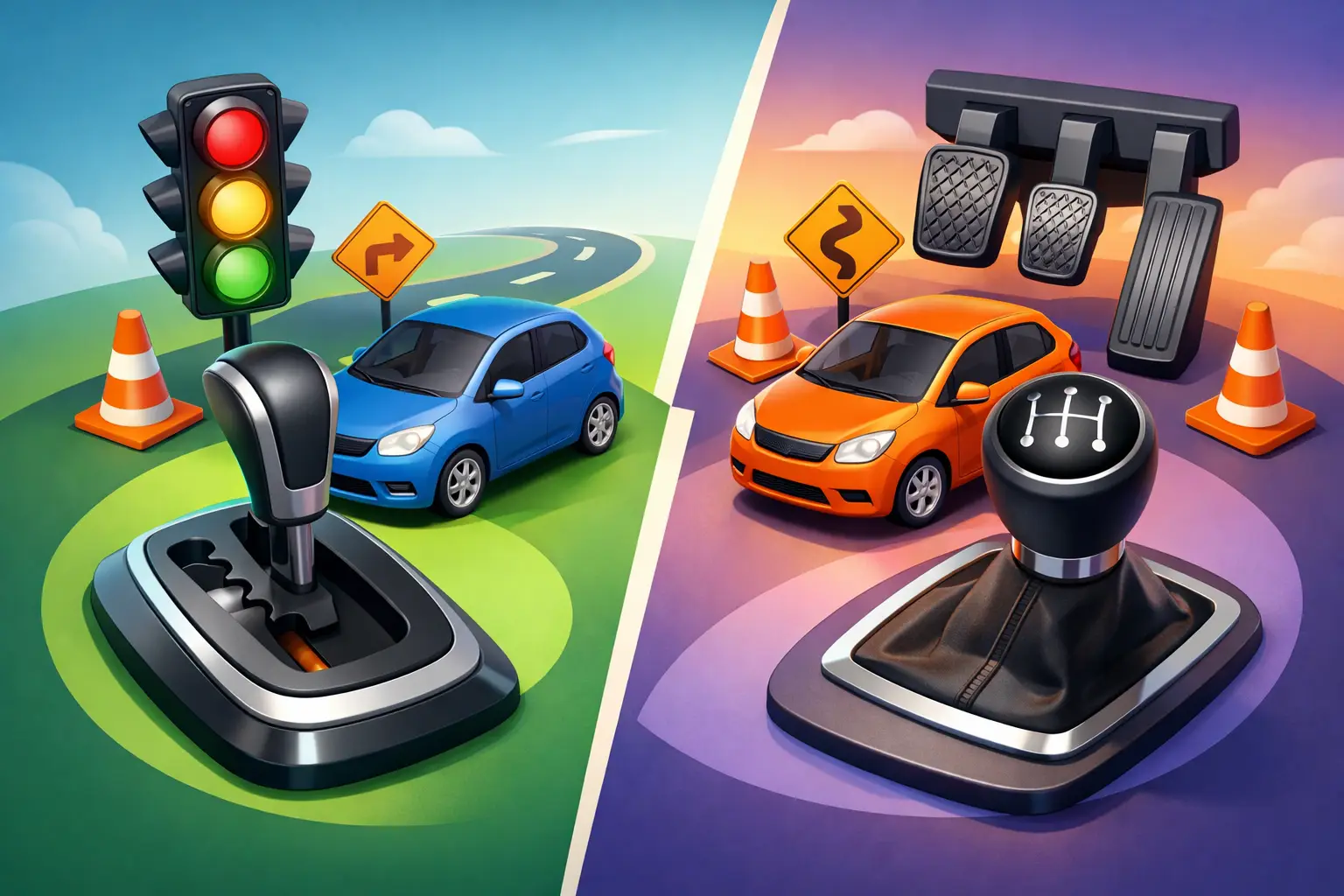
The biggest difference is simple. In a manual car, you control the gears and the clutch yourself. In an automatic, the car changes gear for you.

That changes the whole learning experience. Manual lessons ask you to manage clutch control, gear changes, hill starts, stopping smoothly, moving off cleanly and steering at the same time. Automatic lessons remove a big chunk of that workload, which means many learners can focus sooner on road awareness, positioning, mirrors, timing and decision-making.

Neither route is cheating. Neither route makes you a worse driver. The test standard is still the test standard. You still need safe judgement, strong observation and full control of the vehicle.

What changes is how much you have to think about while learning.

When automatic driving lessons make more sense

If your main priority is passing quickly, automatic often gives you a shorter route. That matters if you need a licence for work, university, commuting or family commitments and you do not want your lessons dragged out by repeated clutch issues.

Automatic lessons suit learners who feel overwhelmed in busy traffic, especially around Manchester routes where junctions, roundabouts and stop-start driving can pile on pressure fast. If the car is doing the gear changes, you have more headspace to read the road and react calmly.

They can also be a strong choice if you have already tried manual and found yourself stuck on the same problems. Plenty of learners are not bad drivers – they are just losing progress because the clutch and gears keep interrupting everything else.

That is why automatic is often a practical choice for nervous beginners, retest learners, busy professionals and anyone working to a deadline. If the goal is to become test-ready efficiently, fewer moving parts can make a real difference.

When manual driving lessons are worth it

Manual still gives you the broadest licence. Pass your test in a manual and you can legally drive both manual and automatic cars. Pass in an automatic and you are restricted to automatics only.

That flexibility matters if you want more choice when buying a first car, borrowing a family car or looking at job roles where a manual licence may still be useful. Manual cars are also often cheaper on the used market, although that gap is changing as more drivers move towards automatic and electric vehicles.

Manual lessons can be the better long-term option if you are not in a rush and you are comfortable learning a more technical skill. Yes, they can take longer for some learners, but plenty of people pick it up well once they get consistent practice with a structured instructor.

If you want maximum freedom after passing, manual is still the stronger option.

Which is easier to pass in?

For many learners, automatic feels easier to learn in because there is less to juggle. That does not mean the test is easy. It means the learning curve can be smoother.

Manual learners often spend a large part of early lessons dealing with stalling, clutch bite, gear timing and coordination. Until those basics settle down, it is harder to make quick progress in the parts of driving that actually decide whether you are safe and test-ready.

In an automatic, you can often start building confidence on junctions, roundabouts and independent driving sooner. That can lead to faster progress, especially if you are taking intensive lessons or trying to prepare in a tight timescale.

But easier is not always better for everyone. Some learners enjoy the control of a manual and feel more engaged once they get past the first stage. If manual clicks for you early, there is no reason to switch just because somebody says automatic is simpler.

Cost matters – but not just the lesson price

A lot of learners look at the hourly rate first. That is understandable, but it is not the full picture.

Automatic lessons can sometimes cost slightly more per hour because automatic instructors and cars can be in higher demand. Manual lessons may look cheaper on paper, but if you need many more hours to become test-ready, the lower hourly price does not always save money overall.

This is where your learning speed matters. If automatic helps you reach test standard sooner, the total spend may end up close to manual or even lower in some cases. If manual suits you naturally and you progress well, then manual may offer better value and more flexibility after you pass.

The key question is not just, “What is the hourly rate?” It is, “What is likely to get me passed efficiently?”

Your confidence level should shape the choice

Confidence is not a soft extra in driving lessons. It affects how quickly you learn, how well you recover from mistakes and how ready you feel on test day.

If you are already anxious about traffic, roundabouts or being judged, manual can sometimes pile on pressure too early. One rough lesson with repeated stalls and clutch issues can knock your confidence harder than it should. Automatic often strips away that initial frustration and helps learners settle into driving sooner.

On the other hand, some people build confidence by learning the harder option first. They like understanding exactly how the car works and feel more capable once they can manage it themselves. That type of learner may find manual more rewarding, not more stressful.

Be honest with yourself. The right choice is the one that keeps you progressing, not the one that sounds toughest or most impressive.

Automatic or manual driving lessons for fast results

If speed is your priority, automatic usually has the edge. Fewer technical tasks means many learners can move through the basics faster and spend more lesson time on real test routes, manoeuvres, planning and hazard response.

That is especially useful for intensive courses, where every lesson hour counts. If you are aiming to pass before a job starts, before term begins, or after a recent failed test, reducing complexity can help you use your time better.

That said, speed only works if the course is structured properly. The best results come from matching the learner to the right car type, the right instructor and the right lesson plan from the start. A rushed manual course for someone who hates clutch control is not efficient. Neither is pushing automatic on somebody who is clearly comfortable in a manual.

This is where a proper assessment matters. A good school will help you choose based on experience, confidence and timeframe – not guesswork.

Questions to ask before you decide

Before booking, think about your actual target. Do you need a licence quickly for work? Have you had manual lessons before? Are you a complete beginner? Do you expect to buy an automatic car after passing? Would a manual licence give you more useful options?

Also consider where you will be learning. In busy urban areas, some learners prefer automatic because it makes stop-start traffic less draining. Others are happy to tackle manual because they want to build that skill in real-world conditions from day one.

There is no one-size-fits-all answer. The right decision depends on your pressure, budget, confidence and what success looks like for you.

The best choice is the one that gets you moving

Too many learners waste time trying to pick the “best” option in theory. What matters is what gets you passed with confidence and puts you in a position to drive independently afterwards.

If you want broader flexibility and you are happy with a steeper learning curve, manual is a strong investment. If you want a simpler path, quicker progress and less overload in lessons, automatic may be the better fit. At Express Pass, that decision should always come down to results, not pride.

Pick the route that keeps your progress sharp, your confidence high and your test goal within reach. The right lessons are the ones that get you on the road, not the ones that keep you thinking about it.

Categories
Driving school in Manchester

How Much Is a Driving Crash Course?

How Much Is a Driving Crash Course?

If you need a licence quickly, one question matters more than most: how much is a driving crash course? The short answer is that it depends on how many hours you need, whether you learn in a manual or automatic car, and how close you already are to test standard. In the UK, most crash courses sit anywhere from a few hundred pounds for a short retest package to well over £2,000 for a full beginner course.

That price range sounds broad because crash courses are built for very different learners. Someone who has already done 25 hours and just needs a focused push before test day will not pay the same as a complete beginner starting from scratch. The smart move is not hunting for the cheapest figure – it is finding the right course length so you do not overpay for hours you do not need, or underbook and end up needing more lessons later.

How much is a driving crash course in the UK?

Most driving crash courses are priced by the number of lesson hours included. As a rough guide, a short 10-hour course for a retest or confidence top-up may cost around £300 to £500. A 15 to 20-hour course often lands between £600 and £900. A 25 to 30-hour intensive course is commonly priced from £900 to £1,400. If you are a beginner who needs 35 to 45 hours, the total can rise to £1,400 to £2,000 or more.

Those figures usually cover tuition time, but not always everything else. Some schools include the practical test fee, some do not. Some include a theory support package, mock test, or help matching you to the right course, while others charge separately. That is why two schools can both advertise a 20-hour crash course and still come out at very different final prices.

In Manchester and other busy areas, prices can also be a little higher than the national average. Instructor availability, local demand and test-centre pressure all play a part.

What changes the price?

The biggest factor is your current level. If you can already move off safely, handle roundabouts and drive independently with only minor faults, you may only need a short intensive course. If you are brand new behind the wheel, you will need far more hours and a more structured build-up.

Transmission matters too. Automatic crash courses are often priced slightly higher per hour because automatic instructors and cars can be in shorter supply. That said, some learners pass faster in an automatic, which can reduce the total number of hours needed. A higher hourly rate does not always mean a higher overall spend.

Then there is the course format. Some schools spread intensive lessons over one or two weeks. Others compress them into a few long days. A tighter schedule can suit motivated learners, but it is not right for everyone. If you get mentally tired after two hours, packing in six hours a day may not be the best value, even if it looks fast on paper.

Instructor experience, vehicle type and local demand also affect price. A DVSA-approved instructor with strong pass-rate support, mock tests and a clear lesson plan may charge more than a budget option. For many learners, that extra structure is worth it if the goal is passing fast without wasting time.

Cheap crash course or good value?

This is where learners get caught out. A low headline price looks attractive, but it does not always mean good value. Some cheap courses exclude the practical test, use shorter lesson slots than expected, or leave little room for actual test preparation. Others may sell a package that is too short for your level, which means you pay again for extra hours.

A better question than how much is a driving crash course is this: what do I get for the money? You want to know how many hours are included, whether the lessons are one-to-one, whether the practical test is included, what happens if you do not use all your hours, and how the school decides which package suits you.

Good value means clear pricing, proper guidance and a course that matches your real ability. It also means support beyond the lesson itself – things like theory resources, mock tests, and honest advice on whether you are test-ready.

Typical price bands by learner type

If you have failed a test recently and only need polish work, a 10 to 15-hour crash course is often enough. This is the most affordable route and works well for learners who already have decent control and just need sharper decision-making, manoeuvres or independent driving practice.

If you have some experience but stopped lessons months ago, a 20 to 30-hour course is more realistic. You may remember the basics, but gaps in confidence usually show up quickly, especially at roundabouts, junctions and when driving under pressure.

If you are a complete beginner, expect a higher spend. Intensive courses can still save time, but they do not remove the need to learn core skills properly. For many beginners, 35 to 45 hours is a sensible starting point, sometimes more if confidence is low or private practice is limited.

That is why honest course matching matters. A school that pushes every learner into the same package is not helping you pass faster. It is just making the booking easier for them.

Is a crash course cheaper than weekly lessons?

Sometimes yes, sometimes no. On a pure hourly basis, a crash course may be similar in price to weekly lessons or slightly cheaper if bought as a package. The real saving is usually time, not just pounds.

Weekly lessons can drag on for months because learners forget between sessions, struggle to maintain momentum, or face constant delays around work, study and life. Intensive learning reduces that gap. You practise regularly, build muscle memory quicker and stay focused on one clear goal – passing.

That said, crash courses are not magic. If you are highly anxious, have never sat in the driver’s seat before, or struggle to process a lot of information quickly, weekly lessons may suit you better at first. For some learners, the best option is a mix: build a base with standard lessons, then move into an intensive course when the test is in sight.

How to choose the right course without overspending

Start with brutal honesty about your current level. If you are guessing, you risk booking the wrong package. A proper assessment or conversation with a school should help identify whether you are a beginner, partly trained, near test standard or retest-ready.

Next, ask what is included. You should know whether the practical test fee is part of the package, whether mock tests are available, and whether there is a refund policy for unused hours. That last point matters more than many learners realise. If you progress faster than expected, you should not be paying for time you do not use.

Look at support as well as price. A fast-track course works best when the structure is strong. That means reliable scheduling, a clear lesson plan, test-readiness guidance, and instructors who know how to coach under time pressure. Express Pass, for example, focuses heavily on matching learners to the right course so they can move quickly without wasting money on the wrong package.

When paying more makes sense

There are times when the cheaper option costs more in the long run. If a higher-priced course gives you a better instructor match, more focused preparation and stronger support, it may cut the number of extra lessons and retest costs later.

This matters most if your deadline is tight. Maybe you need your licence for a new job, university, or family commitments. In that situation, reliability matters. You want a school that can organise lessons efficiently, keep momentum high and help you stay test-focused. Saving £100 upfront means little if poor planning delays your progress by weeks.

The real answer to how much a driving crash course is

A driving crash course can cost anything from around £300 to £2,000 plus, depending on your experience, the number of hours required and the type of support included. For most learners, the right budget sits somewhere in the middle, not at either extreme. Enough hours to do the job properly, but not so many that you are paying for time you do not need.

If you want the best result, focus on value, fit and speed together. The cheapest course is not always the fastest route to a pass, and the most expensive one is not always necessary either. Get clear on your level, choose a course built around your goal, and make sure every pound is moving you closer to test day with confidence.

Categories
Driving school in Manchester

Are Intensive Driving Courses Worth It?

Are Intensive Driving Courses Worth It?

If you need a full licence fast, it is fair to ask: are intensive driving courses worth it? For plenty of learners, the answer is yes – but only when the course matches your experience, confidence level and timetable. A fast-track course can save weeks or months of waiting around, but speed on its own does not guarantee a pass.

The real value comes from structure. Instead of dragging lessons out over half a year, you train consistently, build momentum and stay focused on one result – getting test-ready as quickly and confidently as possible. That is why intensive courses appeal to learners starting a new job, heading to university, managing family commitments or simply fed up with slow progress.

Are intensive driving courses worth it for every learner?

Not for every learner, no. They are a smart option for the right person, and a poor fit for the wrong one.

If you already have some driving experience, an intensive course can be especially effective. Maybe you have had 10 or 20 lessons already, can move off safely, handle roundabouts reasonably well and just need sharper test preparation. In that case, condensing your learning into a short period often helps you improve faster because you are not re-learning the same things each week.

They can also work well for complete beginners, but only if the course is planned properly. New drivers need time to absorb routines, road awareness and decision-making. A rushed course with too many hours packed into each day can leave a beginner mentally drained. A well-structured course, on the other hand, builds skill step by step and keeps the pressure manageable.

Then there are retest candidates. This group often gets the biggest benefit. If you have recently failed and know your weak areas, an intensive course gives you a focused reset. You can correct faults, take mock tests and go into your next test while everything is fresh.

Why intensive courses work so well for some people

The biggest advantage is continuity. In weekly lessons, it is common to spend the first part of each session remembering what happened last time. With intensive training, you pick up where you left off. That creates better rhythm, quicker correction of mistakes and faster improvement.

There is also a practical advantage. Many learners do not want driving lessons hanging over them for months. They want a plan, a clear number of hours and a realistic path to test standard. That level of structure suits busy people. It also suits learners who stay motivated when there is a deadline in sight.

Confidence can improve more quickly too. Driving regularly over a short period means manoeuvres, junctions, dual carriageways and independent driving stop feeling like isolated challenges. They become part of a routine. Repetition builds calm, and calm matters on test day.

From a money point of view, intensive courses can be good value if they reduce wasted time. A course that gets you to test standard efficiently may work out cheaper than endless weekly lessons with no real end date. That said, value is not just about the headline price. It depends on how well the course is matched to your current ability.

When an intensive course may not be worth it

If you are highly anxious behind the wheel, a very condensed schedule may be too much too soon. Some nervous learners do better with more space between lessons, giving them time to process what they have learned and come back calmer next time.

It may also be the wrong choice if your schedule is chaotic. Intensive courses rely on consistency. If you are likely to cancel, rearrange or arrive mentally distracted every day, you lose one of the main benefits.

Another issue is unrealistic expectations. Some learners hear “intensive” and assume it means guaranteed fast results. It does not. You still need the ability to learn quickly, take feedback on board and perform under pressure. If you need more hours, you need more hours. A good driving school should tell you that clearly rather than selling speed for the sake of it.

There is also the simple fact that not every learner absorbs skills at the same rate. Some people become test-ready fast. Others need a steadier build. That is normal. The course is only worth it if it fits the learner, not if it chases a marketing promise.

The main trade-off: speed versus breathing space

This is where the decision usually sits. Intensive driving courses are built for momentum. Weekly lessons are built for spacing things out.

Momentum is powerful. You stay in learning mode, bad habits get corrected quickly and test skills stay sharp. But breathing space has value as well. Some learners improve when they have a few days between lessons to think, watch the road as a passenger and settle their nerves.

That is why course matching matters. A beginner with no road confidence may need a longer intensive plan spread across more days. A learner with previous experience may be ready for a shorter course. The best result usually comes from choosing the right pace, not simply the fastest one.

Are intensive driving courses worth it compared with weekly lessons?

If your goal is to pass as quickly as possible, they often are. Weekly lessons can still get you there, but progress is usually slower and less consistent. Life gets in the way. Lessons get missed. Skills go rusty. Motivation dips.

An intensive course reduces that drift. It gives you a fixed plan and keeps your attention on one milestone. For learners with a deadline, that can make all the difference.

But if you are in no rush, enjoy learning gradually and prefer lower weekly spending, hourly lessons may suit you better. There is nothing wrong with that route. The better option is the one that gives you the highest chance of becoming a safe, confident driver – not just the one that sounds quickest.

How to tell if an intensive course is actually good value

Start with honesty about your level. If you are a beginner, do not book a short course meant for someone who has already covered the basics. If you have failed a test recently, do not pay for more hours than you need. Good value starts with accurate course matching.

Next, look at what support is included. Strong intensive courses are not just blocks of driving time. They should give you proper planning, realistic advice, test-readiness guidance and an instructor who knows how to teach efficiently without piling on pressure.

It also helps to check flexibility. Manual or automatic, female instructor on request, mock tests, theory support and a clear policy on unused lesson hours all add practical value. They reduce friction and make it easier to commit to the process.

For learners in Manchester who want a fast, structured route to test standard, that is exactly why schools like Express Pass appeal. The focus is not just speed for the sake of it. It is speed with a plan.

Who gets the best results from intensive courses?

The strongest candidates tend to be learners who are motivated, available and ready to treat driving like a short-term project. That includes students trying to pass before term starts, professionals who need a licence for work, and retest candidates who want to correct faults while the previous test is still fresh in their mind.

Learners with some prior experience often make the quickest gains. They are not starting from zero, so concentrated practice helps them bridge the gap between “almost there” and test-ready. Complete beginners can still do very well, but they need a realistic number of hours and the right pace.

So, are they worth it?

Yes – if you want a quicker route to your test, can commit the time and choose a course that matches your ability. No – if you are forcing yourself into a schedule that leaves you overwhelmed, underprepared or paying for the wrong level of support.

That is the real answer. Intensive driving courses are not a shortcut around learning properly. They are a faster, more focused way to do the learning when the format suits you.

If you are serious about getting on the road, think less about whether intensive is always better and more about whether it is better for you. The right course can save time, sharpen your confidence and get you test-ready without months of stop-start lessons. The key is choosing a pace you can actually learn from.

Categories
Driving school in Manchester

Automatic Intensive Driving Course Manchester

Automatic Intensive Driving Course Manchester

If you need an automatic intensive driving course Manchester learners can start quickly, you are probably not looking for months of drifting through one lesson a week. You want a clear plan, a realistic timescale and an instructor who knows how to get you test-ready without wasting hours. That is exactly where an intensive automatic course makes sense.

Automatic lessons are often the quickest route for learners who want to focus on road awareness, positioning, judgement and test standards without also managing clutch control and gear changes. For many people, that means faster progress and less mental overload. If your goal is simple – pass efficiently and get on the road – automatic can be the smart move.

Why choose an automatic intensive driving course in Manchester

Manchester is not a gentle practice ground. You have busy roundabouts, complex junctions, stop-start traffic, bus lanes, city-centre pressure and residential roads that demand constant attention. Learning in this kind of environment builds real driving skill, but it also means your lessons need structure.

An automatic intensive driving course in Manchester helps by compressing your learning into a focused block. Instead of spending a week forgetting what happened in your last lesson, you build momentum day after day. That matters when you are trying to improve quickly.

For nervous learners, automatic tuition can feel more manageable because there is less to think about at once. For busy learners, the intensive format saves time. For people who have failed a test before, it creates a sharper plan with less room for bad habits to settle back in.

That does not mean automatic is right for every single learner. If you know you want the freedom to drive both manual and automatic cars in the future, manual may still be the better long-term option. But if your priority is passing fast, driving confidently and getting a licence for work, uni or daily life, automatic is often the fastest route from learner to full licence.

Who an automatic intensive course suits best

This type of course works well for complete beginners, but it is especially useful for learners who already have some experience and do not want to drag the process out. If you have had a few lessons before, paused learning, or recently failed a test, an intensive course can help you reset and move forward properly.

It is also a good fit for people on a deadline. Maybe you need a licence before starting a new job. Maybe commuting is eating up too much time. Maybe you are heading to university and want the independence before term starts. In these situations, a slow and open-ended lesson schedule can feel frustrating. A structured course gives you a target and a timetable.

Working professionals often prefer automatic because it reduces the stress of learning around a packed week. Parents returning to driving lessons after years away often choose it for the same reason. And for some learners, especially those who feel anxious behind the wheel, fewer moving parts means more confidence from the start.

What to expect from an automatic intensive driving course Manchester package

A proper intensive course should not just be a pile of hours. It should be matched to your level, your confidence and how close you are to test standard. That is where many learners waste money – booking too many hours they do not need, or too few to actually be ready.

A strong course usually starts with a simple assessment of your experience. A beginner will need a different plan from someone who can already handle roundabouts, bay parking and independent driving. Once that is clear, your training can be organised into a practical schedule that keeps you improving without burning you out.

You should also expect support beyond just sitting in the car. Good preparation includes mock tests, theory support where needed, honest feedback and guidance on choosing the right course length. If you need a female instructor, that should be easy to request. If you need lessons around work or family commitments, flexibility matters.

That is the difference between random lesson booking and a course designed to get results. The best schools do not just sell speed. They give you a realistic route to passing at pace.

The biggest advantage – momentum

The real power of an intensive course is momentum. Driving is a skill built through repetition, recall and correction. When your lessons are close together, you remember what went wrong yesterday and fix it today. That is far more efficient than repeating the same issue every week because too much time has passed.

Momentum also helps confidence. One good lesson can carry into the next. A rough lesson can be corrected before it becomes a bigger problem. You stay focused, and the course keeps moving.

There is a trade-off, though. Intensive learning is demanding. If you try to cram too many hours into too few days, your concentration can drop and your progress can flatten. The right course is not always the shortest one. It is the one with enough time for proper learning, rest and steady improvement.

How to choose the right course length

There is no single package that suits everyone. A learner who has never driven before may need a much longer course than someone who has already covered most of the syllabus. Being honest about your current level saves time and money.

If you are a beginner, expect to need a fuller block of tuition. If you are partly trained, a mid-range course may be enough to sharpen up weak areas and build consistency. If you are preparing for a retest, a shorter intensive plan can work well if your faults are specific and manageable.

The right provider will tell you what makes sense, not just push the biggest package. That matters. A course should feel targeted, not inflated. Express Pass, for example, builds around course matching guidance so learners are not left guessing what they need.

Learning in Manchester – why local knowledge matters

Driving in Manchester requires more than basic car control. You need to handle traffic flow, lane discipline, busy urban routes and the kind of decision-making that only comes from proper coaching in local conditions. An instructor with experience in the area can help you prepare for the pace and pressure of real roads, not just textbook driving.

That local knowledge becomes even more valuable on an intensive course because every lesson hour counts. You do not want to waste time covering the wrong things or practising in places that do not stretch your ability. You want your weak areas identified quickly and your training adapted around them.

A DVSA-approved instructor should also give direct, test-focused feedback rather than vague encouragement. You need to know what is holding you back, what is improving and what needs more attention before test day.

Fast does not mean rushed

A lot of learners worry that intensive means pressured. It should not. Fast progress comes from structure, consistency and the right teaching approach, not from being thrown in at the deep end.

A good instructor will still build things step by step. You should be challenged, but not overwhelmed. If your confidence needs building first, that should be part of the process. If your manoeuvres are strong but your observations need work, the course should shift towards that. Speed works best when the plan stays realistic.

This is especially true for learners who have failed before. The answer is not always more hours. Sometimes it is better quality hours, delivered with sharper feedback and a proper focus on the faults that matter.

What to look for before you book

Before choosing a course, check whether the school offers automatic instructors, clear pricing, support with test-readiness and flexibility around your schedule. A money-back guarantee on unused lesson hours is also a strong sign that the provider is confident in its course planning.

It is also worth asking how they help learners who want to find an earlier test date. The right support can save time, but it should be explained clearly and honestly. You want practical guidance, not vague promises.

Most of all, look for a school that treats your goal like a deadline worth respecting. If you need to pass fast, every part of the process should support that – from the first call to the final mock test.

An automatic intensive course can be the quickest, cleanest route to a full licence if it is built around your actual level and delivered with focus. If your next chapter depends on getting on the road, the best time to start is when you are ready to commit properly.

Categories
Driving school in Manchester

Driving Course With Test Included Explained

Driving Course With Test Included Explained

If you need your licence quickly, a driving course with test included can save a lot of back-and-forth. Instead of sorting lessons first and the practical test later, you book a structured package designed to move you from your current level to test standard on a clear timeline. That matters when you are juggling work, uni, family commitments, or a retest you do not want hanging over you for months.

The main appeal is simple. You get a focused block of tuition and a test plan built around it. For many learners, that feels easier than dragging lessons out week by week and hoping everything lines up at the right time. It is faster, more organised, and usually less stressful when the course is matched properly to your experience.

What a driving course with test included actually means

A driving course with test included is usually an intensive or semi-intensive package that combines a set number of lesson hours with a practical driving test arranged to fit the course schedule. The exact format varies, so this is where people can get caught out. Some packages include the test fee within the headline price, while others include the course and the test booking support but charge the DVSA fee separately.

That difference matters. If you are comparing prices, make sure you know whether “test included” means the practical test is fully paid for, simply scheduled as part of the package, or added at checkout. A lower upfront price is not always better value if key parts are missing.

A good provider should also be clear about what level the course is built for. A complete beginner needs a very different structure from someone who has already done 30 hours and just needs polish before a retest. The best results come from honest course matching, not from squeezing every learner into the same package.

Who this type of course suits best

This option works especially well for learners with a deadline. Maybe you need to drive to a new job, want your licence before moving to university, or simply cannot keep stretching lessons over six months. When time matters, a focused plan is usually more effective than scattered weekly sessions.

It also suits people who learn better through momentum. Regular driving over a short period helps many learners build confidence faster because they are not spending each lesson re-learning what they forgot last week. Skills such as clutch control, roundabouts, lane discipline and manoeuvres tend to stick better when practice is consistent.

That said, intensive does not automatically mean better for everyone. If you are a very nervous beginner, you may still benefit from a more gradual pace or a semi-intensive course instead of trying to cram everything into a few days. Fast should still feel manageable. The goal is to pass confidently, not just rush to test day under pressure.

How the process usually works

Most providers start by finding out where you are now. That could mean asking about previous lessons, test attempts, confidence level, and whether you want manual or automatic. From there, they recommend the right course length.

A shorter package often suits partly trained learners or people coming back after a recent fail. A longer one is usually needed for beginners. Some schools also offer mock tests and theory support, which can make a real difference if your weak point is not car control but test readiness.

Once the course is matched, the lessons are scheduled in a concentrated block. That might be over one week, two weeks, or spread around work and family commitments. Then the practical test is placed to line up with the end of the course, so your driving is freshest when it counts.

This is where a well-run school stands out. You want clear communication, realistic advice, and instructors who teach with the test in mind without turning every lesson into a box-ticking exercise. Passing quickly is the aim, but proper road confidence still has to come first.

What to check before you book

The phrase sounds straightforward, but not every driving course with test included offers the same value. Before booking, check what the package actually covers, how many hours you will get, and whether the course is suitable for your experience level.

You should also ask whether the car hire for the practical test is included. In many cases it is, but it is worth confirming. Turning up and finding out that the test slot is covered but the use of the instructor’s car is not can turn a good deal into an expensive one.

Instructor quality matters just as much as price. A DVSA-approved instructor, a good local pass record, and experience preparing learners for intensive courses are all worth looking for. If you have preferences such as a female instructor, or you need automatic lessons to move faster, it helps to choose a school that can match those needs from the start.

Refund policy is another detail people skip until it is too late. If your course needs to change or you do not use all your hours, transparent terms matter. Clear policies usually signal a school that is confident in its service rather than one relying on small print.

Manual or automatic for a faster pass?

If your priority is speed, automatic often gives learners a shorter route to test standard. You do not need to master clutch control and gear changes, which means some people can focus sooner on road position, observations and hazard response. For busy professionals or nervous beginners, that can be the difference between passing in weeks rather than months.

Manual still makes sense if you want maximum flexibility after passing or if you are already comfortable with gears. It can also be better value long term depending on the cars you expect to drive. But if you have already delayed learning because manual feels overwhelming, automatic is often the smarter choice, not the easier excuse.

The right answer depends on your goal. If your main target is getting on the road fast, automatic deserves serious consideration. If your target is broader licence flexibility and you have time to build the skill properly, manual may still be the better fit.

Why course matching matters more than the headline price

A cheap package is not a bargain if it leaves you underprepared. This is one of the biggest mistakes learners make when comparing courses. They look at the number on the page and ignore whether the package is realistic for their current level.

For example, a learner who has done a few lessons but still struggles at busy junctions, mirrors and independent driving may not be ready for a short retest package, even if it looks affordable. On the other hand, someone with solid experience could waste money on a long beginner-style course they do not need.

The better approach is to book based on fit. A provider that asks the right questions and recommends the right number of hours is doing you a favour, even if the course costs slightly more. Paying for the right structure once is usually cheaper than paying for the wrong one twice.

The benefit of local support in Manchester

If you are learning in and around Manchester, local knowledge is a real advantage. Busy roundabouts, varied road types, changing traffic conditions and familiar test-area pressure points all become easier when your instructor knows the area well.

That local edge helps with more than route familiarity. It also helps with lesson planning, scheduling around your availability, and keeping your course moving without unnecessary delays. A school built around fast-track learners should be set up for urgency, not forcing you through a slow admin process before you even get behind the wheel.

That is why many learners look for a provider such as Express Pass – not just for intensive tuition, but for structured support, practical guidance, and course options that fit real-life deadlines.

Is a driving course with test included worth it?

For the right learner, yes. If you want a clearer route to passing, fewer moving parts, and a timetable that keeps you progressing, it is often the most practical option. You are not just paying for lesson hours. You are paying for structure, pace and less wasted time.

Still, it only works when the course is realistic. Too few hours, poor instruction, or a package that sounds better than it is can leave you frustrated and out of pocket. The strongest choice is not the most aggressive promise. It is the course that matches your level, gives you proper support, and gets you to test day ready.

If you need your licence soon, do not just ask how fast you can start. Ask whether the course is built to give you a genuine shot at passing well, because getting on the road fast only matters if you are ready to stay there.

Categories
Driving school in Manchester

2 Week Driving Course Manchester Guide

2 Week Driving Course Manchester Guide

Needing a licence quickly usually means one thing – you have got a job lined up, university is coming up, or you are simply done with dragging lessons out for months. A 2 week driving course Manchester learners choose is built for exactly that moment. It gives you a short, focused route to test standard, but it only works well when the course matches your experience, your availability and how you learn under pressure.

Is a 2 week driving course in Manchester right for you?

For the right learner, two weeks is enough time to make serious progress and, in some cases, reach test standard fast. That is the appeal. You are not waiting months between lessons, forgetting what you covered last time, or trying to fit one hour here and there around work.

But speed is only useful if the structure is right. An intensive course suits learners who can commit proper time, stay mentally switched on, and handle regular feedback without losing confidence. If you are motivated and want momentum, this format can be a strong fit.

It is especially useful for three types of learner. First, complete beginners who want a clear plan from the start. Second, partly trained learners who have already done some hours and need to sharpen up quickly. Third, people preparing for a retest who need focused correction rather than months of repeat lessons.

If your schedule is chaotic, your theory test is not sorted, or you get overwhelmed easily by long driving sessions, it may be better to spread lessons over a longer period. Fast does not mean rushed. The best result comes from choosing a course pace you can genuinely handle.

How a 2 week driving course Manchester plan usually works

A proper intensive course is not just lots of hours thrown together. It should be structured around assessment, steady progress and test readiness. That means your starting point matters.

If you are new to driving, your first sessions will focus on core control, junctions, mirrors, moving off safely, positioning and building confidence in traffic. In Manchester, that also means getting used to busy roundabouts, changing road layouts, buses, cyclists and the stop-start pace that can catch nervous learners out.

If you already have experience, the course should not waste your time covering what you can already do. Instead, it should identify your weak spots early. That might be bay parking, meeting traffic, lane discipline, hesitation, clutch control or independent driving. The goal is to close the gap between “I can drive” and “I can pass”.

Most two-week plans work best when lessons are arranged across consecutive weekdays, sometimes with some weekend flexibility depending on availability. That consistency helps you retain more from each session. You are practising, correcting and improving while everything is still fresh.

A good provider will also look at the full picture, not just driving hours. That includes theory support if needed, mock test practice, guidance on the right course length and help with understanding how to look for a suitable driving test date. What matters is keeping the whole process moving, not leaving you to figure it out alone.

What makes intensive learning effective

The biggest advantage is momentum. Weekly lessons often mean you spend the first 15 minutes remembering what happened last time. In an intensive course, you pick up where you left off. Skills settle faster because repetition is built in.

Confidence often grows quicker too. Many learners struggle because they spend too long in the uncertain middle stage – not beginners anymore, but not test-ready either. A two-week course compresses that period. You keep facing the same types of roads, hazards and manoeuvres until they start to feel normal.

There is also a practical benefit. If you need a licence for work, commuting or family reasons, an intensive course can cut out months of delay. That matters when your timeline is real, not theoretical.

Still, there are trade-offs. Longer sessions can be tiring, especially in heavy traffic or if you are learning in a manual car and clutch control is still inconsistent. Some learners thrive under that pressure. Others perform better with more time between lessons. Honest course matching matters more than promising every learner they can pass in fourteen days.

Manual or automatic – which is better for a two-week course?

This depends on your goal.

If you want the broadest licence option and are comfortable with a steeper learning curve, manual can be the better long-term choice. You will need to master gears, clutch control and hill starts alongside everything else, so the workload is heavier. For some learners, that is manageable in two weeks. For others, it slows progress.

Automatic usually shortens the learning curve because you can focus more on road awareness, planning and decision-making without dealing with gear changes. If your priority is passing fast and driving mainly in urban areas, automatic can be a smart move. It is particularly popular with nervous learners, busy professionals and people who have already struggled with manual lessons.

Neither option is automatically better. The right choice is the one that gives you the best chance of becoming safe and test-ready within your timeframe.

What to expect on Manchester roads

Manchester is a useful place to learn because it exposes you to real driving conditions quickly. You are likely to meet complex junctions, multi-lane roundabouts, bus lanes, school traffic, narrow residential roads and busy dual carriageways all within a short distance. That can feel intense at first, but it is good preparation.

A strong intensive course should not avoid the difficult bits. It should build you up to them. Learners need experience of varied road types, changing traffic density and the kind of pressure that often causes faults on test. That includes reading signs early, choosing the correct lane in good time and staying calm when the road gets busy.

This is where a local, DVSA-approved instructor makes a difference. You want someone who knows how Manchester traffic behaves, understands the common pressure points learners face and can keep lessons focused on what actually improves your chance of passing.

Choosing the right course length and support

Not everyone needs the same number of hours. That is one of the biggest mistakes learners make when booking quickly. A two-week course is a timeframe, not a magic number.

A beginner may need a larger block of hours within that period. Someone with previous experience may need a shorter refresher package with mock test work. A retest candidate might only need targeted correction over a few days. The point is to match the course to your current level, not to guess and hope.

That is why assessment and honest advice matter. The best intensive schools will tell you if two weeks is realistic, what format suits you, and where your current standard sits. They should also give you flexibility, clear pricing and reassurance that unused lesson hours are not simply lost if your needs change.

For many learners, support around the lessons matters just as much as the lessons themselves. Mock tests, theory resources, female instructors on request, and clear communication all reduce friction. When you are trying to pass fast, small delays and uncertainty can knock your confidence more than you expect.

How to give yourself the best chance of passing fast

Treat the course like a short-term project with a clear result. Keep your two weeks as clear as possible. Get enough sleep. Review feedback after each lesson. If your instructor flags the same issue twice, make it a priority the next day.

Use private practice if it is available and safe to do so with a suitable supervising driver. Even short sessions on moving off, clutch control, parking or roundabouts can help reinforce what you are learning professionally.

Most importantly, stay coachable. Intensive courses move quickly, so there is less room for stubborn habits. Learners who improve fastest are usually the ones who take feedback well, ask questions and stay focused on progress rather than perfection.

A service like Express Pass works best when that urgency is matched with proper structure – the right instructor, the right course level and the right support around the test process. When those pieces line up, two weeks can be enough to change your options completely.

If you need your licence soon, do not waste time trying to force the wrong course. The smart move is to choose a plan that fits your starting point, commit to it fully, and give yourself the best shot at getting on the road fast.

Categories
Driving school in Manchester

How Fast Can You Pass Driving Test?

How Fast Can You Pass Driving Test?

Need a licence quickly because uni starts soon, a new job requires you to be mobile, or you are simply fed up relying on lifts? The big question is always the same: how fast can you pass the driving test? The honest answer is that some learners can be ready in as little as two weeks, while others need longer. What matters is not just speed, but reaching test standard properly so you can pass with confidence rather than rushing in and hoping for the best.

How fast can you pass the driving test in reality?

If you already have some experience, the process can move fast. A learner who has passed theory, understands the basics, and only needs polishing may be ready for a practical test after a short intensive course. Someone starting from scratch usually needs more time, but that still does not mean months of dragging lessons out with no clear plan.

A realistic fast-track timeline depends on three things: your current ability, your availability for lessons, and test availability. If those line up, the journey can be much quicker than many people expect. For some learners, especially retest candidates or those who stopped lessons in the past, a concentrated block of training is often the fastest route back to test standard.

The key point is simple. Passing quickly is possible, but only when the training is structured around a clear goal rather than random weekly lessons with no momentum.

What actually decides your timeline?

The biggest factor is your starting point. A complete beginner will need to learn vehicle control, road positioning, junctions, roundabouts, manoeuvres, independent driving, and the habits that make you safe under pressure. That takes focused practice. A partly trained learner may already have half of that in place, which shortens the timeline sharply.

Your confidence also matters, but not in the way people think. Being bold is not the same as being test-ready. Some learners feel confident early on but still make repeated observation or decision-making mistakes. Others feel nervous yet drive safely and consistently. The driving test rewards control, awareness, and judgement – not bravado.

Then there is lesson frequency. One lesson a week can work, but it is rarely the fastest way to pass. Skills fade between lessons, especially early on. Intensive courses or multiple lessons per week help you build rhythm, fix mistakes faster, and keep everything fresh.

The final piece is admin. If your theory test is not passed, or you leave practical test booking too late, your timeline slows down even if your driving improves quickly.

The fastest route is not always the cheapest route

This is where a lot of learners get stuck. They try to save money by spacing lessons out, only to spend more over time because progress is slower and bad habits take longer to fix. If you need to pass quickly, concentrated learning is often better value overall.

That does not mean every learner needs a huge course. It means choosing the right amount of tuition for your level. If you need 10 focused hours to tidy up weak areas, that is smarter than paying for 30 hours you do not need. If you are a beginner, trying to cut corners usually backfires.

Good training should feel targeted. You should know what you are working on, what is improving, and what still needs attention before test day.

Can you pass in 2 weeks?

Yes, some learners can. But not everyone should aim for that.

A two-week pass is most realistic for learners who have already had lessons, recently stopped driving, or failed a test and need a focused reset. In those cases, a structured intensive course can sharpen weak areas quickly and build test confidence without months of delay.

For complete beginners, two weeks is possible in some cases, but it depends on your ability to learn quickly, stay calm under pressure, and commit serious time to lessons and private practice. It also depends on having your theory test sorted and a practical test date available.

This is where course matching matters. Booking too few hours leaves you underprepared. Booking too many can waste money and time. The fastest learners are usually the ones on the right course for their current level, not the ones trying to force the shortest option.

How to pass your driving test faster without cutting corners

If your goal is speed, you need to be strategic. Start by being honest about your level. If you are a beginner, say so. If you can drive but struggle with roundabouts or parking, say that too. A realistic starting point saves time.

Next, sort your theory test early. There is no point getting near practical standard and then waiting because the paperwork is not in place. Theory preparation should run alongside your driving, not after it.

After that, increase lesson frequency. Short bursts of training spread over months are rarely ideal for urgent learners. A more concentrated schedule helps you improve faster because mistakes are corrected while they are still fresh.

Mock tests are also worth taking seriously. They show whether you can hold it together under test conditions, not just drive well when your instructor is helping. Plenty of learners can drive well in lessons and still throw marks away through poor decisions when the pressure goes up.

Finally, be selective with your private practice. More hours help only if the practice is useful. Repeating the same comfortable routes does not prepare you for a proper test. You need varied roads, realistic decision-making, and proper supervision.

Common reasons learners take longer than they should

One of the biggest delays is inconsistency. If you have lessons here and there with long gaps, your progress slows. You spend too much time recapping instead of moving forward.

Another problem is booking a test before reaching the right standard. That sounds fast, but it often creates a fail, extra cost, and more delay. A rushed attempt can set you back mentally as well as practically.

Some learners also avoid the areas they are weakest on. They hope manoeuvres, dual carriageways, or busy roundabouts will somehow click later. Usually, they do not. The fastest progress comes from tackling weak spots early and repeating them until they become routine.

Then there is simple lack of structure. If every lesson feels different with no clear target, it becomes harder to measure progress. A strong training plan should move you from basics to test-level driving in a logical order.

Who can usually pass the quickest?

Retest candidates often progress fastest because they have already covered most of the syllabus. Usually, they do not need to learn how to drive from the beginning. They need to correct a few recurring faults, rebuild confidence, and get sharp again under test conditions.

Learners with previous experience also tend to move quickly, especially if they stopped recently. The knowledge is often still there, even if the confidence needs work.

Working professionals and students can do well with intensive training too because they often like clear timelines and measurable goals. When the schedule is fixed and the target is close, focus tends to improve.

Beginners can absolutely pass quickly as well, but they need the right mindset. You have to be coachable, available, and willing to work on the bits you find uncomfortable.

Is an intensive course the best option?

If your priority is getting on the road fast, often yes. Intensive courses compress the learning process, reduce wasted time between lessons, and help you build momentum. That is especially useful if you need a licence for work, commuting, or a major life change.

The trade-off is that intensive learning requires commitment. You need to stay focused, absorb feedback quickly, and turn up ready to work. It is not a magic shortcut. It is simply a faster, more structured path when it matches your learning style and experience.

For some learners, a mix works better – a concentrated course followed by a small number of extra lessons to sharpen final details. That can be a strong balance between speed and confidence.

A school such as Express Pass is built around exactly that kind of practical decision-making: matching the course to the learner, helping secure an earlier test, and keeping the process moving without unnecessary hold-ups.

So, how fast can you pass the driving test and still do it properly?

Fast enough to make a real difference to your plans, but only if the pace matches your current level. For some people, that is two weeks. For others, it is a few more. The smartest move is not chasing the shortest timeline on paper. It is choosing a focused route that gets you to test standard quickly, safely, and with enough consistency to pass when it counts.

If you want the fastest path, think less about luck and more about structure. The right lessons, the right timing, and the right preparation can save weeks or even months – and once you are genuinely ready, the test feels a lot less like a gamble.

Categories
cheetham hill driving instructors Driving School Driving school in Manchester

Timeline to Passing Your UK Driving Test in 2026?

Timeline to Passing Your UK Driving Test in 2026?

How Long Does It Take to Pass Your UK Driving Test in 2026?

In the UK, learning to drive and passing your driving test is a significant milestone, but how long it actually takes to get there in 2026 depends on various factors. While the process remains largely the same, the duration for learners varies depending on their experience, confidence, and how much driving practice they get. Let’s dive into what you can expect in terms of timelines, process, and factors that influence how long it will take for you to pass your driving test in 2026.

1. The Process of Learning to Drive

Before you can take your practical driving test in the UK, you must first pass the theory test. This two-part test consists of a multiple-choice section and a hazard perception test, designed to assess your knowledge of road signs, rules, and how to handle different driving situations.

Once you pass the theory test, you can begin taking driving lessons. Here’s a typical outline of the process:

  • The Theory Test: The theory test typically takes around 1 to 2 months of preparation for most people. You can start studying for it while still taking driving lessons, as many driving schools offer combined theory and practical training.

  • Learning to Drive: The time it takes to learn to drive can vary significantly. On average, learners in the UK take 45-50 hours of professional driving lessons. However, this is only an estimate, and some people may take more or less time depending on their ability, the frequency of lessons, and their confidence behind the wheel.

  • Additional Practice: Many learners also choose to practice with family or friends outside of their lessons, which can help to reduce the number of lessons needed. Some learners may only need 20-30 hours of lessons, while others may require more extensive training.

2. Booking Your Driving Test

After completing your lessons and feeling confident in your ability, you can then book your driving test. As of 2026, booking a practical driving test can often be a lengthy process. Test availability varies by location and can be affected by demand. Due to the increasing number of learners and limited testing slots, some areas experience longer waiting times.

It’s important to note that waiting times for driving tests have increased in many areas of the UK, with some learners having to wait several weeks or even months to secure a test date. The average waiting time in 2026 is around 8-12 weeks, but this can fluctuate based on where you live. For example, in busy urban areas, the wait may be longer.

3. Factors Influencing How Long It Takes

Several factors influence how long it will take to pass your UK driving test in 2026:

  • Availability of Test Dates: As mentioned, test availability can vary. Popular areas often have longer wait times, which can extend your overall learning process.

  • Personal Ability: Every learner is different. Some learners pick up driving skills quickly and pass the test in a matter of months, while others may need more time to build confidence and skills.

  • Frequency of Lessons: The more frequently you take lessons, the quicker you’ll progress. Consistency is key when learning to drive, so those who take lessons weekly or bi-weekly typically progress faster than those who take them sporadically.

  • Test Failures: Unfortunately, not everyone passes their driving test on the first attempt. If you do fail, you’ll need to book another test and continue practicing, which will delay your goal of passing.

4. What If You Fail Your Test?

Failure rates can vary, but around one in three drivers fail their first practical driving test in the UK. If you don’t pass, don’t worry. It’s a normal part of the process for many people. After failing, you’ll need to:

  • Wait for a New Test: You’ll need to book another driving test. However, there may be another waiting period, which can extend the time it takes to pass.

  • Additional Lessons: Many people who fail their first test take additional lessons to address specific areas where they struggled. These can help improve driving skills and boost confidence for the next attempt.

5. The Impact of COVID-19

The COVID-19 pandemic significantly impacted driving tests in the UK, leading to test backlogs and delays in 2020 and 2021. Although the situation has improved in 2026, some areas are still catching up, and you may still face longer waiting times for your driving test.

6. The Future of UK Driving Tests in 2026

In 2026, the UK government is expected to continue improving driving test infrastructure. This might include expanding test centers, offering more flexible test dates, and even embracing technology such as virtual driving tests (although these are not yet widespread). However, it’s likely that waiting times and the overall process will continue to be impacted by demand, making it important to plan ahead and book your test as early as possible.

Conclusion: How Long Does It Take to Pass Your UK Driving Test in 2026?

In summary, while the duration to pass your UK driving test in 2026 depends on many factors, most learners can expect the following rough timeline:

  • Theory Test: 1-2 months

  • Driving Lessons: 6-12 months (average of 45-50 hours)

  • Test Waiting Time: 8-12 weeks, depending on location

If you pass on the first attempt, it can take approximately 6 to 12 months from starting your lessons to obtaining your driving license. However, this can be influenced by factors such as the availability of test dates, how quickly you learn, and the number of test attempts.

Categories
Driving school in Manchester

Get Behind the Wheel Sooner: How to Fast-Track Your Driving Test in 2025

Get Behind the Wheel Sooner: How to Fast-Track Your Driving Test in 2025

Waiting to take your practical driving test in the UK can feel like an eternity, with some DVSA test centres in 2025 quoting wait times of up to five months. If you’re itching to hit the road and claim your driving freedom, these delays can be a real buzzkill. But don’t worry—there are smart, practical ways to skip the long queue and snag an earlier test slot. Here’s how to make it happen.


Why Are Driving Test Waits So Long?

The struggle is real, and here’s why:

– Everyone wants to drive. The demand for tests is sky-high as more people than ever are eager to get licensed.

– Not enough examiners. Some test centres are still short-staffed, making it harder to clear the backlog.

– Slots vanish fast. New test appointments are often snapped up in minutes, leaving latecomers stuck.

Knowing what’s causing the delays can help you plan smarter and beat the system.


Top Tips to Fast-Track Your Driving Test

1. Book Early, Stress Less

Don’t wait until you’re a pro behind the wheel to book your test. As soon as you pass your theory exam, grab a slot. You can always push it back later if you need more practice, but booking early gets you in the game.

2. Team Up with a Driving School

Some driving schools, like ExpressPass Driving School, have clever systems to track cancellations and book earlier slots for their students. It’s like having a secret weapon to jump the queue.

3. Hunt for Cancellations

DVSA releases new test slots throughout the day. Check their website early in the morning, during lunch breaks, or in the evening to catch freshly dropped appointments. Persistence pays off!

4. Be Open to Nearby Test Centres

Don’t limit yourself to your local centre. Casting a wider net—say, 10–15 miles away—can uncover hidden slots with shorter waits. A quick trip could mean driving home with your licence sooner.

5. Try an Intensive Driving Course

Want to speed things up? Intensive courses cram lessons and test prep into just 1–2 weeks, getting you test-ready fast. Plus, many schools bundle fast-track test bookings with the package, so you’re sorted from start to finish.

6. Watch Out for Scams

Yes, fast-track tests are legit—they’re just earlier slots booked through the official DVSA system. But steer clear of shady third-party services charging crazy fees for “guaranteed” dates. Stick to DVSA-approved channels or trusted driving schools to keep things safe and straightforward.


Get on the Road Sooner

Long wait times don’t have to derail your driving dreams. By booking early, staying flexible, and teaming up with a driving school that offers fast-track options, you’ll be cruising with your licence in no time.


Ready to Hit the Gas?

At ExpressPass Driving School, we’re all about getting you on the road fast with our fast-track test bookings and intensive courses across Manchester. Our expert instructors and booking team are here to make it happen—sometimes in just weeks!

📞 Give us a call today to kickstart your driving journey!

Categories
Driving school in Manchester

What To Do If You Get Into A Minor Car Accident?

What To Do If You Get Into A Minor Car Accident?

A minor car accident can be stressful, even if there are no major injuries or damages. Whether it’s a small bump in traffic or a parking lot scrape, knowing what to do next can help you stay safe and handle the situation efficiently. Here’s a step-by-step guide on what to do if you get into a minor car accident.

1. Stay Calm and Check for Injuries

Take a deep breath and remain as calm as possible. Check yourself and any passengers for injuries. If anyone is hurt, even slightly, call emergency services immediately.

2. Move to a Safe Location

If the accident is minor and your vehicle is drivable, move it to a safe spot, such as the side of the road, to avoid blocking traffic. Turn on your hazard lights to alert other drivers.

3. Check for Vehicle Damage

Once you are safely parked, inspect your car and the other vehicle involved. Look for visible damages and take note of any scratches, dents, or broken parts.

4. Exchange Information

Even for a minor accident, you need to exchange details with the other driver. Collect the following information:

  • Name and contact details
  • Driver’s license number
  • Vehicle registration number
  • Insurance information
  • Make, model, and color of the vehicles involved

If there are any witnesses, try to get their contact details as well.

5. Take Photos and Notes

Document the scene by taking clear photos of the vehicles, any visible damage, the surrounding area, and any relevant road signs or signals. This can help with insurance claims and provide evidence if needed.

6. Avoid Admitting Fault

Even if you feel responsible for the accident, avoid admitting fault at the scene. The insurance companies will determine liability based on the evidence and reports.

7. Contact the Authorities (If Necessary)

For minor accidents, it may not be required to call the police, but it’s always good to check local laws. If the damage is significant or if there is a dispute, calling the police can help get an official accident report.

8. Notify Your Insurance Company

Report the accident to your insurance provider as soon as possible. Provide them with the necessary details, including photos and witness information, to help with the claims process.

9. Get a Vehicle Inspection

Even if your car seems fine, it’s a good idea to have it checked by a mechanic. Some damages may not be visible immediately but could cause problems later.

10. Learn from the Experience

Reflect on what happened and see if there are ways to prevent similar accidents in the future. Whether it’s being more cautious in traffic or understanding blind spots better, learning from the incident can make you a safer driver.

Final Thoughts

Minor car accidents can be frustrating, but handling them correctly can save you time, stress, and money. Stay calm, follow these steps, and always prioritize safety. If you’re learning to drive, practicing defensive driving techniques can help reduce the risk of accidents.

For professional driving lessons that help you build confidence on the road, contact Express Pass Driving School today!


Categories
Driving school in Manchester

What To Expect During Your First Driving Lesson

What To Expect During Your First Driving Lesson

Taking your first driving lesson is an exciting milestone, but it’s natural to feel a little nervous. At Express Pass Driving School, we ensure that every learner feels comfortable and confident from the very first session. If you’re wondering what to expect, here’s a step-by-step guide to help you prepare.


1. Meeting Your Instructor

Your driving lesson will begin with your instructor picking you up from your agreed location. They will introduce themselves, check your provisional driving license, and explain what you’ll be covering in the session.

👉 Tip: If you wear glasses or contact lenses, make sure to bring them, as you’ll need to read a number plate from 20 meters away for the eyesight test.


2. Getting to Know the Car

Before hitting the road, your instructor will introduce you to the car’s controls. You’ll learn about:

✅ The accelerator, brake, and clutch (for manual cars)
✅ How to adjust your seat, mirrors, and steering wheel
✅ The handbrake and gears
✅ Indicators and dashboard controls

This is your chance to ask questions and get comfortable with the vehicle.


3. Learning Basic Driving Skills

Once you’re ready, your instructor will guide you to a quiet area, like a residential street or an empty car park, to start practicing the basics. This may include:

🚗 How to start the engine and move off smoothly
🚦 How to stop the car safely
🔄 Steering control and positioning
🔁 Simple turns and checking mirrors

Your instructor will give clear, step-by-step instructions to build your confidence at a comfortable pace.


4. Practicing Essential Road Skills

Depending on your progress, you may also learn:

✔️ How to use clutch control (for manual cars)
✔️ Changing gears smoothly
✔️ Approaching junctions and roundabouts
✔️ Understanding road signs and markings

Remember, the first lesson is all about getting comfortable behind the wheel—you won’t be expected to master everything straight away!


5. Ending Your Lesson & Feedback

At the end of your lesson, your instructor will provide feedback on your strengths and areas to improve. They’ll also discuss what you’ll cover in your next session.

👉 Tip: Take a few notes after your lesson to remember key points and what to practice next.


Final Thoughts: Stay Calm & Enjoy the Process!

Your first driving lesson is a learning experience, not a test. The more relaxed and focused you are, the quicker you’ll gain confidence on the road.

At Express Pass Driving School, our experienced instructors are here to guide you every step of the way. If you’re ready to start your driving journey, book your first lesson today! 🚗💨

Categories
Driving school in Manchester

Top 5 Tips for Passing Your Driving Test on the First Try

Top 5 Tips for Passing Your Driving Test on the First Try

Passing your driving test on the first attempt is an exciting milestone, and with the right preparation, you can make it happen! At Express Pass Driving School, we specialize in helping learners gain confidence and skills to succeed. Here are our top five expert tips to help you pass your test the first time.

1. Take Professional Driving Lessons

Investing in lessons with a qualified driving instructor is key. They’ll teach you proper driving techniques, test routes, and what examiners look for. Our instructors at Express Pass Driving School provide structured lessons tailored to your skill level, ensuring you’re fully prepared.

Pro Tip: Book a mock driving test with your instructor to simulate real test conditions.

2. Know the ‘Show Me, Tell Me’ Questions

During your test, the examiner will ask you one “Tell Me” question (before driving) and one “Show Me” question (while driving). These cover basic car safety and maintenance, like checking oil levels or turning on headlights.

Pro Tip: Practice these questions with your instructor so you answer confidently on test day!

3. Master Manoeuvres and Observations

Manoeuvres like parallel parking, bay parking, and pulling up on the right are commonly tested. However, many learners lose marks for poor observation rather than the manoeuvre itself.

Pro Tip: Always check your mirrors, signal appropriately, and look over your shoulder when necessary to show the examiner you are fully aware of your surroundings.

4. Stay Calm and Manage Test Day Nerves

It’s natural to feel nervous, but staying calm is essential for driving safely. Get plenty of rest before your test, arrive early at the test center, and take deep breaths if you feel anxious.

Pro Tip: If you make a mistake, don’t panic! Keep driving safely—small errors won’t necessarily result in a fail.

5. Know Your Test Routes

While the test route isn’t fixed, examiners often use similar roads and junctions. Practicing in these areas gives you an advantage.

Pro Tip: Ask your instructor to take you on common test routes to familiarize yourself with the roads and tricky junctions near your test center.

Final Thoughts

Passing your driving test the first time is achievable with the right preparation, mindset, and instructor support. At Express Pass Driving School, we specialize in helping learners pass with confidence.

🚗 Ready to book your driving lessons? Contact us today and get on the road to success!

Categories
Driving school in Manchester

Why More People Are Opting for Intensive Driving Courses in 2025

Why More People Are Opting for Intensive Driving Courses in 2025

In recent years, the demand for intensive driving courses has skyrocketed, and 2025 is proving to be no different. More learners are choosing fast-track lessons over traditional weekly sessions, and for good reason. Whether you’re looking to pass quickly, boost confidence on the road, or fit learning into a busy schedule, intensive driving courses are becoming the preferred choice. Let’s explore why this trend is on the rise.

1. Faster Results – Pass in Weeks, Not Months

One of the main reasons people are opting for intensive driving courses is the speed of results. Traditional lessons can take months or even years to complete, whereas an intensive course can help learners pass their driving test in as little as a few weeks. With many people eager to get their licence quickly for work, studies, or personal independence, this accelerated approach is highly appealing.

2. Cost-Effective in the Long Run

While the upfront cost of an intensive driving course may seem higher, it often proves to be more cost-effective in the long run. Spreading lessons over several months means more hours are needed to retain knowledge and improve skills. In contrast, intensive courses provide focused and consistent practice, reducing the overall number of lessons required.

3. Higher Pass Rates

Studies show that learners who take intensive courses tend to have a higher first-time pass rate compared to those taking weekly lessons. The immersive nature of intensive courses means that students retain information better and develop muscle memory faster, leading to greater confidence and better test performance.

4. Convenient for Busy Schedules

Many people in 2025 are juggling work, education, or family responsibilities, making it difficult to commit to long-term weekly lessons. Intensive driving courses offer flexibility with condensed learning schedules, allowing students to fit their training into a short period that works best for them.

5. Ideal for Nervous Learners

Driving anxiety is common, and for some learners, spreading lessons out over months can increase stress and forgetfulness. Intensive driving courses provide a focused and immersive experience, helping nervous drivers gain confidence quickly without the long gaps between lessons that can lead to setbacks.

6. Adapting to the Modern Driving Test

With the UK driving test evolving over the years to include more real-world driving scenarios and independent navigation, intensive courses are designed to cover all aspects of modern driving efficiently. Learners are better prepared to handle real-life situations, ensuring they are not only test-ready but also road-ready.

7. More Instructors Offering Intensive Courses

Driving schools across the UK, including Express Pass Driving School, are increasingly offering tailored intensive courses to meet demand. With experienced instructors who specialize in fast-track learning, students can be assured of a structured and effective learning experience.

Is an Intensive Driving Course Right for You?

If you’re looking to pass your driving test quickly, save money in the long run, and boost your confidence behind the wheel, an intensive driving course could be the perfect option. At Express Pass Driving School, we offer tailored intensive courses designed to help you succeed. Contact us today to fast-track your driving journey in 2025! 🚗💨

Book your intensive driving course today and get on the road faster!

Categories
Driving school in Manchester

Top Safety Tips for New Drivers in 2025

Top Safety Tips for New Drivers in 2025

Becoming a new driver is an exciting milestone, but it also comes with great responsibility. In 2025, with evolving road regulations, new technology, and increasing traffic, staying safe on the road is more important than ever. Here are the top safety tips every new driver should follow to ensure a smooth and secure driving experience.

1. Master the Basics of Defensive Driving

Defensive driving means being aware of potential hazards and reacting in a way that prevents accidents. This includes:

  • Keeping a safe following distance (at least 3 seconds behind the car in front).
  • Anticipating other drivers’ actions and staying alert.
  • Avoiding distractions, like texting or adjusting the radio while driving.

2. Stay Up to Date with Road Laws & Regulations

Laws and regulations can change over time. In 2025, updates to speed limits, ULEZ (Ultra Low Emission Zone) regulations, and mobile phone use laws mean you should always stay informed. Check the DVSA (Driver and Vehicle Standards Agency) website for the latest rules.

3. Use Technology Wisely

Modern vehicles are equipped with advanced safety features like lane assist, automatic braking, and blind-spot detection. While these tools can help, remember:

  • Never rely solely on technology—always check mirrors and blind spots manually.
  • Keep your car’s software updated for optimal performance.
  • Avoid overusing autopilot or semi-autonomous features without full attention.

4. Be Cautious in Adverse Weather Conditions

Driving in rain, fog, or icy conditions requires extra caution. To stay safe:

  • Reduce speed and increase stopping distance.
  • Use appropriate lights (fog lights in low visibility, but never high beams in fog).
  • Keep your tyres and wipers in top condition.

5. Avoid Distractions at All Costs

Distracted driving remains one of the top causes of accidents. Stay focused by:

  • Putting your phone on Do Not Disturb mode.
  • Setting up navigation and music before starting your journey.
  • Keeping conversations with passengers minimal when in complex driving situations.

6. Never Drive Under the Influence

In 2025, stricter drink-driving and drug-driving laws make it essential to never get behind the wheel under the influence. Even some prescription medications can impair reaction time, so always check labels and follow medical advice.

7. Always Wear Your Seatbelt

This may seem obvious, but many drivers still neglect seatbelt use. Ensure that:

  • You and all passengers buckle up before moving the car.
  • The seatbelt fits snugly over your chest and lap.
  • Child passengers are in the correct car seats based on their age and height.

8. Keep Your Vehicle Well-Maintained

A well-maintained vehicle is a safer vehicle. Regularly check:

  • Tyre pressure and tread depth
  • Oil, brake fluid, and coolant levels
  • Lights and indicators to ensure full visibility

9. Plan Your Journey in Advance

Unfamiliar roads can be challenging. Before you set off:

  • Use GPS or maps to plan your route.
  • Check for roadworks, traffic, or weather conditions that may affect your trip.
  • Avoid last-minute lane changes or risky shortcuts.

10. Stay Calm & Confident

Nervousness can lead to hesitation, which can be dangerous in traffic. Build confidence by:

  • Practicing in different conditions (e.g., night driving, highways, roundabouts).
  • Taking additional lessons if needed, such as pass plus courses.
  • Remaining patient and avoiding road rage situations.

Final Thoughts

Driving in 2025 requires a combination of traditional safety practices and modern awareness of technology and regulations. By following these tips, new drivers can enjoy their independence while ensuring a safe and responsible experience on the road.

🚗 Need expert driving lessons? Express Pass Driving School provides professional training to help you pass confidently and drive safely. Book your lessons today!


Categories
Driving school in Manchester

How To Stay Calm And Confident During Your Driving Test

How To Stay Calm And Confident During Your Driving Test

Taking your driving test can be nerve-wracking, but staying calm and confident is key to passing. At Express Pass Driving School, we’ve helped countless learners overcome test anxiety and achieve success. Follow these practical tips to stay composed and in control on the big day!

1. Be Well-Prepared

Confidence comes from preparation. Ensure you’ve had enough driving lessons, covered all essential maneuvers, and practiced in different road conditions. If possible, take a mock test with your instructor to simulate real test conditions.

2. Get a Good Night’s Sleep

Avoid cramming the night before your test. Instead, relax, sleep early, and wake up refreshed. A well-rested mind is more alert and responsive, helping you stay calm under pressure.

3. Eat a Light Meal Beforehand

Hunger or low blood sugar can make you feel jittery. Eat a light, balanced meal before your test to keep your energy steady and focus sharp. Avoid too much caffeine, as it can increase anxiety.

4. Arrive Early and Stay Relaxed

Give yourself plenty of time to get to the test center so you’re not rushing. Use this extra time to practice deep breathing exercises or positive affirmations to ease nerves.

5. Focus on Your Breathing

Deep breathing helps reduce stress and keeps you calm. Before starting the test, take a few deep breaths in through your nose and out through your mouth. This will help slow your heart rate and keep you steady.

6. Listen Carefully to the Examiner

Stay focused and listen carefully to the examiner’s instructions. If you don’t understand something, don’t be afraid to ask for clarification. Taking a moment to process instructions can prevent mistakes.

7. Take It One Step at a Time

Instead of worrying about the entire test, focus on one section at a time. Whether it’s parking, junctions, or roundabouts, approach each task calmly and methodically.

8. Don’t Dwell on Mistakes

If you make a mistake, keep going! Many minor mistakes won’t cause you to fail. Stay focused and don’t let one error affect the rest of your test.

9. Think Positively

Visualizing success can improve your performance. Picture yourself driving smoothly and confidently. Remind yourself that you’ve practiced, and you’re fully capable of passing.

10. Trust Your Training

Your driving instructor has prepared you well, and you wouldn’t be taking the test if you weren’t ready. Believe in your abilities, trust your skills, and drive as you normally would during lessons.

Final Thoughts

Staying calm and confident during your driving test is achievable with the right mindset and preparation. At Express Pass Driving School, we’re here to support you every step of the way. Remember to breathe, stay focused, and trust yourself—you’ve got this! 🚗💨

Ready to pass your test with confidence? Book your lessons with Express Pass Driving School today!

Categories
Driving school in Manchester

Which Countries’ Licences Can You Exchange in the UK?

Which Countries' Licences Can You Exchange in the UK?

If you’ve recently moved to the UK and hold a foreign driving licence, you might be wondering whether you can exchange it for a UK licence. The good news is that the UK has agreements with several countries that allow for a straightforward licence exchange—without the need to retake your driving test. In this guide, we’ll explain which countries qualify, the exchange process, and what to do if your country isn’t on the list.


1. Countries Eligible for a UK Licence Exchange

The UK allows driving licence exchanges for residents holding licences from:

A. ‘Designated Countries’ (No Test Required)

If your licence is from one of the following countries, you can exchange it for a UK licence without taking a test:

  • Australia
  • Barbados
  • Canada
  • Falkland Islands
  • Faroe Islands
  • Hong Kong
  • Japan
  • Monaco
  • New Zealand
  • Republic of Korea (South Korea)
  • Singapore
  • South Africa
  • Switzerland
  • Taiwan
  • United Arab Emirates (UAE)
  • Zimbabwe
  • Andorra
  • British Virgin Islands
  • Cayman Islands
  • Gibraltar
  • Republic of North Macedonia
  • Ukraine

You must have obtained your licence in one of these countries before becoming a UK resident.

B. European Economic Area (EEA) & EU Countries

If you hold a full EU or EEA driving licence, you can drive in the UK without exchanging it. However, if you prefer to switch to a UK licence, you can do so voluntarily.

C. Gibraltar and Crown Dependencies (Jersey, Guernsey, Isle of Man)

Licences issued from these territories can be exchanged for a UK licence without taking a test.


2. How to Exchange Your Foreign Licence

If you’re eligible to exchange your licence, follow these steps:

Check Your Licence Eligibility – Use the DVLA’s online tool to confirm your exchange eligibility.
Complete the D1 Application Form – Available at the Post Office or on the DVLA website.
Provide Supporting Documents – You’ll need:

  • Your original foreign licence
  • Proof of UK residency
  • A passport-sized photo
  • The exchange fee (currently £43)
    Send Your Application – Mail your completed form and documents to the DVLA.

Processing typically takes 3 weeks, but it may take longer if further checks are needed.


3. What If Your Country Isn’t on the List?

If your country is not on the designated list, you cannot exchange your licence directly. Instead, you’ll need to:

🚗 Drive in the UK for up to 12 months using your existing licence.
📅 Apply for a UK provisional licence and take the full driving test (theory + practical).
📍 Book a driving test through the DVSA to obtain a UK licence.

For those needing help preparing for the UK driving test, Express Pass Driving School offers expert lessons to get you test-ready quickly.


4. Final Tips for New UK Drivers

  • Learn UK Road Rules – The UK drives on the left, and there are specific roundabout and motorway rules.
  • Check Insurance Requirements – You may need special car insurance if using a foreign licence.
  • Take Refresher Lessons – If you’re new to UK roads, professional driving lessons can boost your confidence.

Need Help Preparing for a UK Licence?

If you’re planning to take your UK driving test, Express Pass Driving School offers:
Refresher lessons for international drivers
Mock driving tests to help you pass first time
Intensive courses for fast-track success

📞 Contact us today to book your first lesson and get ready for the UK roads! 🚗💨


Categories
Driving school in Manchester

Top Tips on Teaching Dyslexic Drivers

Top Tips on Teaching Dyslexic Drivers

Learning to drive is a big milestone, but for dyslexic learners, it can come with unique challenges. As a driving instructor, understanding how dyslexia affects processing speed, memory, and coordination can help create a more effective and supportive learning experience. Here are some top tips for teaching dyslexic drivers to help them gain confidence on the road.


1️⃣ Use Clear, Simple Instructions

Dyslexic learners often process information differently, so keep instructions short, clear, and to the point. Instead of saying:
🚫 “At the next roundabout, take the third exit towards Manchester, but be mindful of the right-of-way.”
✅ Try: “At the roundabout, take the third exit. Check for traffic on your right.”

Breaking instructions into small steps makes it easier for the learner to process and act on them.


2️⃣ Visual Aids & Diagrams Are Key

Since many dyslexic learners struggle with written instructions, using visuals, diagrams, or hand gestures can reinforce learning.
📌 Use sketches to explain road layouts.
📌 Demonstrate mirror checks using your own actions.
📌 Consider GPS apps or digital maps to preview routes before driving.


3️⃣ Multi-Sensory Teaching Works Best

Using a combination of seeing, hearing, and doing helps dyslexic drivers retain information.
Repeat instructions aloud while they perform the action.
✅ Let them walk through a maneuver before attempting it in the car.
✅ Ask them to explain a rule in their own words to reinforce learning.

This hands-on approach boosts memory and confidence on the road.


4️⃣ Extra Time for Processing & Practice

Dyslexic learners may need more time to absorb new concepts, so be patient and allow extra practice.
🚗 Give them a few extra seconds to respond to instructions.
🚗 Practice route repetition—using the same roads helps build familiarity.
🚗 Allow thinking pauses at junctions instead of rushing decisions.

Encouraging a calm, pressure-free environment makes learning much more effective.


5️⃣ Adapt to Their Learning Style

Every dyslexic learner is different, so tailor lessons to suit their strengths.
📌 Some learners benefit from color coding—e.g., using blue for left and red for right.
📌 Others find rhymes and mnemonics helpful, like “Mirror, Signal, Manoeuvre = My Smart Move!”
📌 Encourage voice notes or video recordings instead of written notes to recap lessons.

By adapting to their natural way of learning, you make driving more accessible.


6️⃣ Build Confidence with Positive Reinforcement

Many dyslexic learners have faced challenges in traditional learning environments, so positive feedback is crucial.
🌟 Praise progress, no matter how small.
🌟 Remind them that mistakes are part of learning.
🌟 Encourage self-belief—help them focus on what they CAN do, not just what they struggle with.

Confidence is key to becoming a safe and independent driver!


7️⃣ Consider the Theory Test Challenges

Dyslexic learners may find the driving theory test particularly difficult due to reading and memory challenges. Support them by:
📌 Using audio-based learning apps (e.g., DVSA Theory Test app with voiceover).
📌 Practicing hazard perception videos multiple times.
📌 Breaking study sessions into short, focused bursts to improve retention.

Some learners may qualify for extra time or text-to-speech options—check with the DVSA for accessibility support.


Final Thoughts

Teaching dyslexic drivers requires patience, flexibility, and a tailored approach, but with the right strategies, they can become safe, skilled, and confident drivers. By using clear instructions, visual aids, hands-on learning, and positive reinforcement, instructors can make driving an enjoyable and achievable skill for dyslexic learners.

At Express Pass Driving School, we believe everyone deserves the chance to gain their independence on the road. If you or someone you know needs specialized driving lessons, get in touch today! 🚗💨


Categories
Driving school in Manchester

Driving with Dyslexia: Overcoming Challenges & Building Confidence

Driving with Dyslexia: Overcoming Challenges & Building Confidence

For many learners, driving is an exciting milestone that represents independence and freedom. However, for those with dyslexia, learning to drive can come with unique challenges. From processing road signs to remembering directions, dyslexic drivers often experience difficulties that neurotypical learners may not face. The good news? With the right strategies, support, and mindset, driving success is absolutely achievable.

Understanding the Challenges

Dyslexia affects how the brain processes language and information. While it is often associated with reading difficulties, it can also impact:
  • Short-term memory – remembering multi-step instructions or directions.
  • Processing speed – quickly understanding road signs or spoken instructions.
  • Left-right confusion – difficulty distinguishing between left and right turns.
  • Coordination & sequencing – following the correct order of actions, such as mirror-signal-maneuver.
Recognizing these challenges is the first step in finding effective solutions for dyslexic drivers.

Practical Strategies for Dyslexic Learners

If you have dyslexia, or are teaching someone who does, the following strategies can help make the learning process smoother:

1. Choose the Right Driving Instructor

An experienced, patient instructor who understands learning difficulties can make all the difference. Many driving schools, including Express Pass Driving School, specialize in supporting learners with dyslexia and other conditions.

2. Use Multi-Sensory Learning Techniques

Dyslexic learners often benefit from a combination of visual, auditory, and kinesthetic learning methods. Try:
  • Diagrams & road maps to reinforce routes visually.
  • Verbal repetition of key concepts to improve memory.
  • Hands-on practice with real-time coaching.

3. Utilize Mnemonics & Memory Aids

To combat short-term memory issues, create mnemonics for common driving rules. For example:
  • “MSM” – Mirror, Signal, Manoeuvre
  • “Left = L” (Use hand trick: Make an “L” with thumb & index finger to remember left.)
  • “People Behind May See” – (Check rear-view mirror before slowing down)

4. Leverage Technology & GPS Assistance

Modern technology can be a great support tool:
  • Use voice GPS instead of relying on road signs.
  • Take advantage of driving apps that allow route practice.
  • Record driving lessons to review instructions later.

5. Practice in a Low-Stress Environment

Anxiety can worsen memory and processing challenges. Start driving in quiet, familiar areas before progressing to busier roads. Breaking lessons into shorter, focused sessions can also help avoid information overload.

6. Build Confidence Through Repetition

Repetition is key for dyslexic learners. Practicing specific manoeuvres multiple times strengthens muscle memory and builds automatic responses.

Overcoming the Theory Test Challenge

Many dyslexic learners find the driving theory test more challenging than the practical test. Here’s how to prepare effectively:
  • Take a mock theory test using official apps or websites.
  • Use text-to-speech software for reading questions aloud.
  • Watch video explanations rather than just reading text-based materials.
  • Apply for extra time or special accommodations if needed.

Final Thoughts: Dyslexia Shouldn’t Hold You Back!

Dyslexia presents challenges, but it doesn’t mean you can’t become a confident, capable driver. With adapted learning techniques, patience, and support, you can navigate the road just as well as anyone else. Whether you’re starting from scratch or overcoming past struggles, Express Pass Driving School is here to help make your driving journey a success. If you or someone you know is struggling with driving due to dyslexia, reach out today—we’re here to guide you every step of the way! 🚗💨  
Categories
Driving school in Manchester

Choosing the Right Driving School in Manchester

Introduction:

As a start, one should review the necessity of choosing a proper driving school and consider the driving schools in Manchester

Emphasise the fact that the choice of school can greatly affect the student’s confidence level and performance on the road.

•  Description: Stress that all the Manchester driving schools must use professional and certified trainers only. However, explain the certification that should be in place next.

• Why It’s Important: Explain how experienced instructors are in a better position to offer the right directions and safer ways of handling the car.

•  Description: Describe the components that characterise a complete driving program offered at the driving schools in Manchester.

• Why It’s Important: Provide an overview of learning types and how a diverse schedule is beneficial in addressing everyone’s capabilities to provide a proper driving education.

• Description: It is advised to look into the success rates and search for reviews of driving schools that are located in Manchester.

•  Why It’s Important: Describe how these metrics reflect quality education and customer satisfaction standards.

• Description: Emphasise the necessity of up-to-date and properly maintained vehicles in the driving schools in Manchester.

 Why It’s Important: Safety cannot be overemphasised, and a well-maintained car is less likely to experience mechanical failures or accidents during training sessions.

• Description: Include the aspect of location while selecting a driving school in Manchester.

•    Why It’s Important: Explain how the issues of accessibility might influence the occurrence and smoothness of lessons. Cost and Value Proposition or Cost and Value Assurance

• Description: Explore the prices of lessons at the various mobile driving schools in Manchester and the services that they provide.

• Why It’s Important: They are often tempted to compare the fees charged by different institutions, such as the per-course cost, the first-time pass rates, and the quality of tuition being offered. Conclusion: Conclusion: Briefly outline the main points one should take into account when choosing a driving school. Reinforce Manchester again as the region of focus by repeating the keyword ‘driving schools in Manchester.

Categories
Driving school in Manchester

Accelerating Your Journey to Driving Excellence in Manchester

Accelerating Your Journey to Driving Excellence in Manchester

 And when driving in Manchester, especially in the bustling Cheetham Hill neighborhood, are you prepared to take the wheel? For the ultimate driving school experience and a quick pass, look no further than Express Pass Driving School. The unique qualities of Express Pass Driving School, such as our Fast Pass and Express Pass programs, will be discussed in this extensive article, along with why we are the most excellent driving school in Manchester, emphasizing Cheetham Hill.

One benefit of Express Pass is the Fast Pass program.

  1. 1. Fast Pas Program:Express Pass Driving School knows how valuable time is. Our Fast Pass program is made to speed up getting your driver’s license without sacrificing the caliber of instruction. With rigorous courses that adjust to your learning style, you’ll quickly pick up the skills you need. We are committed to giving you a quick route to success while helping you develop into a secure and assured driver.
  2. Express Pass Experience:Our instructors are mentors who genuinely care about your success, not simply your education. Traditional driving lessons are just one of the things that comes with Express Pass. Our team is committed to helping you at every stage of your learning process and has extensive training and experience. We are aware of the particular difficulties that students in Cheetham Hill encounter, and we have tailored our courses to address those difficulties successfully.
  3. The Greatest Driving School in Manchester:Our Cheetham Hill location of Express Pass Driving School lives up to our reputation as the most excellent driving school in Manchester. What makes us unique is our steadfast dedication to providing top-notch instruction, putting safety first, and ensuring our students are comfortable. Our courses can be tailored to your needs, whether you’re a beginner or looking for more advanced instruction.

For what reason is Cheetham Hill?

  1. Local Knowledge:By selecting Cheetham Hill for your driving instruction, you will use our instructors’ extensive local knowledge. They know about Cheetham Hill’s roads, traffic patterns, and unique driving obstacles. With this knowledge, you may confidently traverse the streets
  1. Convenience:Thanks to our Cheetham Hill location, you’ll spend more time learning and less time traveling. We recognize the importance of your time, and you can easily fit your driving instructions into your routine thanks to our handy location.
  2. High-quality Training:Our Cheetham Hill Express Pass Driving School branch is dedicated to providing top-notch instruction. Every lesson is designed to improve your abilities, understanding, and self-assurance. Our goal is to teach a feeling of responsibility and safety in your driving practices in addition to helping you pass the driving test.

This is Where Your Journey Begins.

 In conclusion, Express Pass Driving School is the best place to go if you’re looking for a quick route to getting your driver’s license in Manchester, especially in Cheetham Hill. We are the obvious choice for driving instruction because of our Fast Pass and Express Pass programs and our reputation as Manchester’s top driving school. Don’t wait; begin your path to being a confident and competent driver. Get in touch with Cheetham Hill’s Express Pass Driving School to expedite your journey to driving proficiency.

 Your road to driving success in Cheetham Hill is not only quick with Express Pass Driving School but also jam-packed with worthwhile experiences and knowledgeable advice. Select us and discover the distinction of becoming a confident and skilled driver.

Categories
Driving school in Manchester

“Unlocking Driving Excellence– Your Fast Pass to Success”

“Unlocking Driving Excellence– Your Fast Pass to Success”

The Benefits of Express Pass: Using Your Fast Pass to Ensure Successful Driving

We at Express Pass Driving School understand how valuable time is. Our cutting-edge rapid pass strategy is made to get you closer to your driving objectives quickly without sacrificing quality. With this special approach, you can be sure that you will get your license speedily and develop into a competent, self-assured driver who can handle any road.

Cheetham Hill’s Top Driving School: Quality in Every Instruction

Why are we Cheetham Hill’s top driving school? Our steadfast dedication to quality. Our staff of knowledgeable instructors is committed to offering thorough and excellent driving instruction. Your progress is our top priority, and we ensure every class advances you toward being a skilled and responsible driver.

Entire Driving Instructions: From Fundamentals to Expertise

Everything is noticed in our driving instructions. Express Pass Driving School offers a thorough curriculum suitable for novice drivers and those looking to improve their skills. From learning the fundamentals to picking up more complex driving skills, we give you the information and abilities you need to drive securely and competently.

UK Driving Schools: Developing Responsible and Expert Drivers

Express Pass Driving School, based in the UK’s center, is proud to support the responsible and competent driving community in the country. Our instructors are knowledgeable in driving laws in the UK, so they can help you pass your test and become a responsible driver who puts road safety first.

Customized Education: Designed to Ensure Your Success

Since every student is different, our driving courses are tailored to your learning style and pace. You are an Express Pass Driving School individual embarking on a life-changing adventure to become a successful driver, not just a student. Our instructors are dedicated to helping you through every step of your driving education to ensure you are equipped for a lifetime of safe and pleasant driving.

Testimonials for Express Pass Driving School: Hear From Our Success Stories

Learn about our satisfied students’ first-hand experiences with the Express Pass Driving School program. Their testimonies attest to the efficiency of our quick-pass approach and the life-changing power of our driving instruction.

Conclusion: 

In the driving world, success is attained by picking the appropriate way. At Express Pass Driving School, we offer more than simply lessons; we provide an express pass to become a skillful, confident, and responsible driver. Count on the top driving school in Cheetham Hill to help you navigate the driving world and pass your test so you can drive safely and enjoyably for the rest of your life. Select Express Pass Driving School, where you can find a quick, effective, and personalized path to success.


Categories
Driving school in Manchester

How to Prepare for Your Automatic Driving Lessons at a Manchester School

 Choosing the Best Driving School in Manchester for Your Needs

Are you looking for a reliable automatic driving school in Manchester? Look no further! Whether you are a new driver eager to hit the road or looking to improve your skills, finding the right automatic driving school is crucial.

Manchester boasts a variety of driving schools offering different programs and packages. From intensive courses to refresher lessons, there is something for everyone.

Are you looking to ace your automatic driving test safely in Manchester? Our driving school in Manchester offers expert and local automatic instructors, flexible schedules, personalized automatic driving lessons, and a cheap automatic driving license to help you become a skilled and confident driver in no time.

Want to Master the roads with confidence?

Choosing the right driving school can significantly impact your learning experience and success. Stay tuned as you explore the top driving schools in Manchester, providing insights into their teaching methods, pass rates, and student reviews. Let’s check the best guide to finding the perfect driving school that suits your needs and helps you achieve your goals.

Unlock your driving potential with the top-rated driving school in Manchester. Our expert instructors provide personalized lessons to help you become a confident and skilled driver in no time.

These are some of the reasons you should take automatic and professional driving lessons:

  1. A driving instructor will teach you proper driving techniques:
  2. You will learn about the various laws and regulations:
  3. You will be able to identify and improve your weaknesses:
  4. A driving school offers a conducive learning environment:
  5. The use of a professional driving instructor can help reduce recklessness:
  6. our professional and automatic driving instructor can easily make you a competent and skilled driver rather than you are a nervous driver.:
  7. Your instructor will teach you defensive driving:
  8. You can pass your driving test more quickly if you train at a driving school:
  1. Various courses are available to suit your needs:
  2. You can Boost your road confidence by automatic driving lessons.

HOW TO PREPARE FOR YOUR AUTOMATIC DRIVING LESSONS AT A MANCHESTER SCHOOL

Automatic transmissions are viral and easier to use than manual driving. Automated driving makes long journeys more comfortable for experienced and new drivers. In intuitive driving courses in Manchester, you can learn how to control your car, your behavior, the rules of the road, and safe driving techniques. If you don’t have experience driving a manual vehicle, learning to drive an automatic car can improve your learning experience and make the moment smoother and progressively more enjoyable. Choose the course that is most suitable for you from our fantastic selection of courses.

Reasons why 6-HOUR INTENSIVE COURSE – (DRIVING TEST INCLUDED) is best for you

£ 480.00

Are you considering taking your driving test, or have you failed and need to retest? You can benefit from our shortest course if that’s the case. You must familiarise yourself with your new vehicle before allowing us to conduct a test to determine whether you are ready for a test.

Benefits of a 10-HOUR INTENSIVE COURSE (DRIVING TEST INCLUDED) in Manchester to build high-level skills

£ 680.00

Have you been driving for years but need a few tweaks to be test-ready? Students who have demonstrated confidence while going with family or friends but need additional practice and guidance to reach test-ready levels benefit from the 10-hour intensive driving course.

Take advantage of 15-HOUR INTENSIVE COURSE (DRIVING TEST INCLUDED) for secure driving.

£ 950.00

Can you pass your driving test without any problems? We have designed our specialized course to target and precisely enhance areas where you may require extra support. You can rely on us to help fine-tune your skills and provide the confidence you need to pass your test.

Develop actual driving skills by 20-hour INTENSIVE COURSE – DRIVING TEST INCLUDED.

£ 1,180.00

If you’re familiar with vehicle controls but need assistance navigating roundabouts, navigating complex traffic systems, and mastering multiple maneuvers, this is the course for you. Throughout the process, we will provide the guidance and support needed to ensure you are test-ready and confident in conquering those challenging aspects of driving!

The Benefits of Choosing a Reputable Driving Learning School in Manchester for Your Fast Driver Training Journey

Manchester is one of the most populated cities in the United Kingdom. Many areas nearby are significant to move around, from automatic driving lessons in Ipswich Suffand, automatic driving lessons in Kidderminster, self-driving lessons in hairstyling, and automatic driving lessons in Liverpool. If you want to perfect your master driving skills with the best driving school in Manchester, there is no better place than Auto Driving School. With Auto Driving School, you will pass your UK automatic driving test in less time.

Imagine navigating the streets of Manchester quickly, knowing you have the skills to handle any situation on the road.

Please don’t wait any longer; enroll in our Manchester driving school today and start your journey to driving safely and competently by starting your driving journey. By registering in our Manchester driving school near you, you can easily pass automatic driving tests by driving classes for manual transmission, and you will be on your way to becoming a safe and competent driver! by getting an intuitive driving license in the UK.